One enters Krasner and Pollock: Past Continuous with Jackson Pollock already lodged in the cultural imagination. His poured filaments belong to modernism’s grammar; even those who have never stood before one recognize the ritual of the man circling a canvas. Somewhere along The Metropolitan Museum of Art’s beautifully calibrated procession, however, the equilibrium alters. Lee Krasner accrues command through discipline, scholarship, formal daring and, eventually, a near-operatic release, until admiration yields to astonishment.
That recalibration is the curatorial masterstroke. Pollock remains every inch the revolutionary we expected, yet Krasner gradually overtakes their shared mythology. What emerges is not the sentimental recovery of an overlooked wife, but the grandeur of a female existence devoted to painting: learned, exacting, desirous, bruised, irreverent and ultimately too expansive for the narrow frame posterity assigned her.
Quite shrewdly, the story begins before their relationship. Krasner was a serious painter years prior to Pollock entering her orbit, not a gifted attendant awaiting proximity to male celebrity to grant relevance. Born in Brooklyn to Jewish immigrant parents, she studied at Cooper Union, the National Academy of Design and under Hans Hofmann. Employment with the WPA and her place within New York’s avant-garde supplied technical mastery, intellectual fluency and an intimate knowledge of Picasso, Matisse and Mondrian, whose lessons she bent through her own rigorous mind.
From the outset, her compositions announce the quality sustained across successive reinventions: delicacy honed to steel. Taut umber lines divide condensed fields into structures suggestive of mosaics, ancient textiles, hieroglyphs or ceremonial notation. The affinities feel archaeological rather than imitative, as though Krasner were excavating an alphabet buried beneath conventional representation. Nothing is casual. Individual marks appear considered, while the tension inside those small enclosures approaches detonation.

Pollock, meanwhile, arrives through a separate inheritance: the American West, Thomas Hart Benton’s sinewy rhythms, Mexican muralism, Surrealist automatism and encounters with Indigenous visual traditions, however romanticized by his era. I anticipated seduction from the celebrated drips. The Moon Woman, however, took me entirely by surprise. Her lunar body rises through vehement contours and feverish pigment, part deity, part omen, holding eros, myth and psychological disturbance within a single apparition. Far earlier than paint streaming across the floor, he was attempting to give the unconscious a skeleton.
Their paths converged during the winter of 1941–42, when John Graham paired them in the same presentation. They married in 1945 and moved to Springs, Long Island, as New York absorbed émigré thought, postwar trauma and a desire to wrest geopolitical prestige from a shattered Europe. Abstract Expressionism emerged from that incendiary atmosphere, offering gesture as evidence and painted surface as an arena where interior experience could erupt publicly.
For Pollock, that ambition assumed choreographic expression. Enamel looped, splintered and pooled as he navigated unstretched surfaces with astonishing physical instinct. More captivating to me are the black pourings, where obscurity ceases to border shape and becomes its substance. Despite my allegiance to chroma, there is something irresistible about that ravenous hue—the absence swallowing all wavelengths and, with them, our convenient illusions. His spectral figures drift between appearance and obliteration. Much later, Rothko’s Chapel cycle would summon a distinct nocturne, quieter yet equally able to consume light until looking verges upon prayer.
Alongside that famous audacity, Krasner’s Little Images answer through concentration. Their calligraphic grids, worked within the dimensions permitted by an upstairs bedroom, prove that consequence has never depended upon acreage. These panels are labyrinthine, analytical and strangely incantatory; close scrutiny uncovers not restraint, but force held under razor-sharp control. Even then, while Pollock’s reputation accelerated and Krasner protected the conditions sustaining his practice, her visual syntax kept mutating through collage, fragmentation and relentless self-interrogation.

Certainly, the domestic arrangement carried brutal inequities. Krasner recognized his gifts, connected him to a sophisticated network, defended the oeuvre and shaped portions of her career in accommodation of his instability. His achievements were seismic; so were his alcoholism, infidelity and ability to make intimacy perilous. Acknowledging that burden does not reduce Pollock to a villain. It refuses the familiar bargain through which a woman’s intellect becomes scaffolding for masculine legend, then disappears once the monument is complete.
When his fatal automobile crash in 1956 also took the life of Edith Metzger, grief ruptured the order Krasner knew. Autonomy cannot be separated from devastation; it arrived laden with bereavement, fury, unfinished devotion and responsibility for preserving his estate. Nonetheless, as her spatial and psychic radius widened, the paintings unfurled with breathtaking assurance. Almost imperceptibly, then completely, the narrative balance reorients.
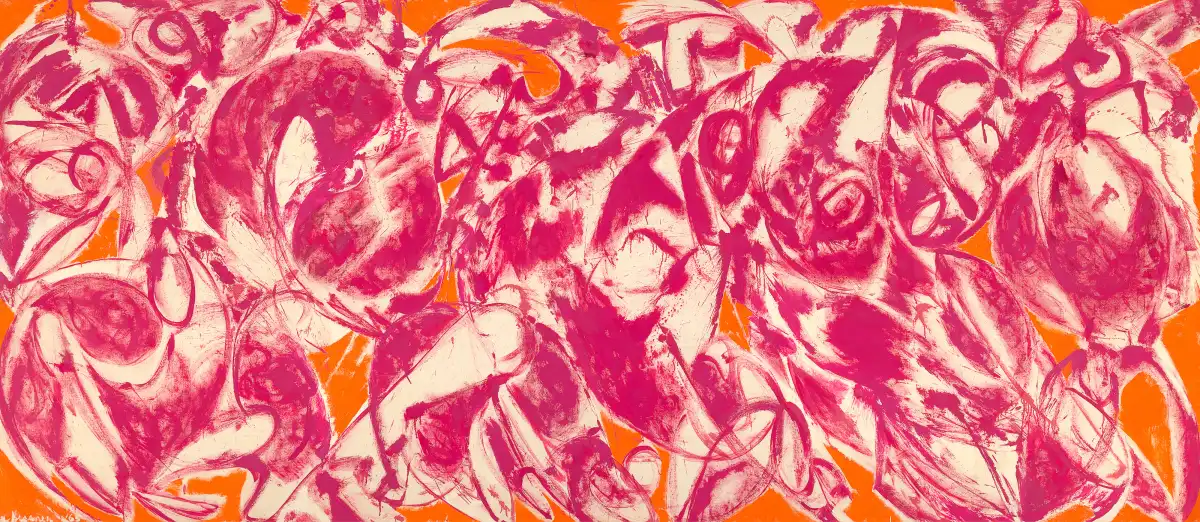
The Seasons, completed in 1957, stretches nearly seventeen feet, its botanical and corporeal shapes surging through pink, viridian, ivory and ebony with sensual abandon. The Earth Green and subsequent Umber canvases grow still more engulfing—cratered, sinuous, pitted, haunted and wildly alive. Sleeplessness drove her toward nocturnal labor and a restricted palette, yet those browns, creams and charcoals never feel depleted. They hold soil, bone, soot, flesh and private agony too unruly for speech.
From there, she triumphs without becoming solemn about it. Gestures swing, collide, flirt and flower; hard edges arrive, vivid hues return, and longstanding dialogues with Matisse, Mondrian and Picasso reopen on her terms. The Eye Is the First Circle and Combat disclose a maker capable of splendor without pomposity, erudition without sterility and emotional violence without surrendering pleasure. Each metamorphosis detonates; in accumulation, they coalesce into a landmine of genius.

Then comes Past Continuous, the monumental 1976 work that lends the exhibition its name, and the entire intellectual argument breaks open across the mind and body. Its vast horizontal field assembles ghostly circles, layered charcoal chambers, severe black interruptions and a solitary red passage burning like a wound that refuses discretion. Figures, gestures and fractured interiors appear to surface, collapse and begin again, holding memory not as a stable archive, but as something restless, corporeal and perpetually revised. Standing before it, I turned to my friend and said, “My God, Krasner went off in the 1970s”—borrowing the vernacular because, in that moment, scholarship felt far too polite for what had just struck the nervous system.
For me, it is her magnum opus: an immersive atlas of evolution and refusal, where pain and joy, womanhood and scholarship, rupture and continuity coexist without submitting to a tidy moral. The title becomes almost sly. Nothing here is merely past; experience doubles back, infiltrates the present and reshapes whatever follows. More than compelling, its storytelling surrounds us, enters us and leaves no neutral ground upon which to stand. In this astonishing expanse, Krasner is secured not simply as a commanding twentieth-century presence, but as one of the most formidable artists reaching decisively into the twenty-first.
Crucially, 1956 did not confer greatness; the preceding rooms have established it. What followed was not an artistic birth, but an expansion—a formidable consciousness no longer required to mold itself to somebody else’s appetite, fragility and acclaim. She remained a widow, steward and creator marked by immeasurable loss; she also became incandescently ungovernable.
Featuring more than 120 objects from over 80 lenders across twelve chapters, Past Continuous is the first exhibition to consider both careers in their full chronological sweep. Krasner’s top billing is therefore neither fashionable revisionism nor reparative politeness. She earns it gallery by gallery, until viewers who entered loving Pollock find themselves overwhelmed by her finesse, temerity and inexhaustible renewal.
Pollock leaves the exhibition no less consequential, while Krasner departs it larger than the record that once diminished her. She does not emerge from his shadow; the installation makes clear that the eclipse belonged to us—to our habits of seeing, inherited hierarchies and willingness to mistake fame for magnitude. Once that veil falls away, she is everywhere: ascending, resisting, reveling and laying rightful claim to her own immensity.
Krasner and Pollock: Past Continuous is on view at The Metropolitan Museum of Art from October 4, 2026, through January 31, 2027.

