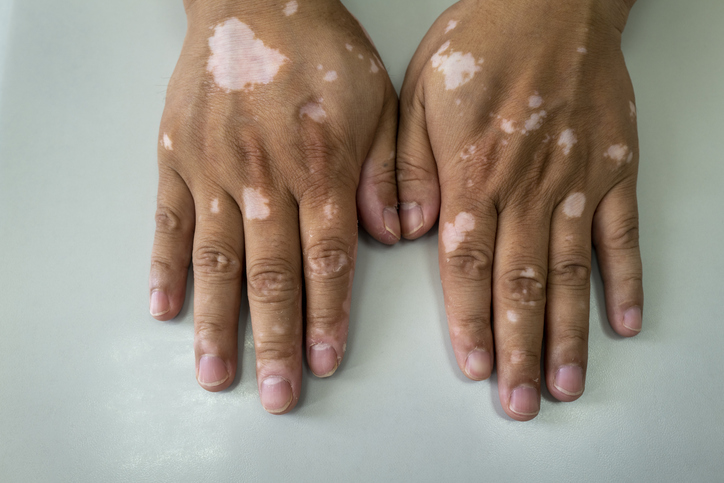
Treatment with Pfizer’s Litfulo led to significant improvement in nonsegmental vitiligo, pivotal clinical trial results that could support a label expansion that brings the oral drug to this prevalent immunological skin disorder.
Detailed Phase 3 data were presented Friday during the European Academy of Dermatology and Venereology annual meeting in Vienna, Austria. Based on these results, Pfizer said it plans regulatory submissions in vitiligo, a chronic condition that currently has limited treatment options.
In vitiligo, the immune system attacks cells that produce melanin, the pigment that gives skin its color. The disease leads to loss of pigment and patches of skin discoloration. Segmental vitiligo affects only one side of the body. The more common non-segmental vitiligo, also called generalized vitiligo, develops on both sides of the body. While the skin changes can appear anywhere, they are most visible on the face, neck, and hands. Vitiligo affects an estimated 1% to 1.5% of the global population, which is about 70 million people, according to the Global Vitiligo Foundation.
Pfizer’s ritlecitinib, brand name Litfulo, is an oral small molecule designed to block the JAK3 and TEC proteins that are part of the immune response driving autoimmune disease. The FDA first approved this once-daily pill in 2023 as a treatment for alopecia areata.
In vitiligo, Pfizer advanced Litfulo in two global Phase 3 studies assessing a high dose and a low dose of the drug. A total of 2,174 patients were enrolled. For both studies in the U.S., the two main goals were measuring the proportion of patients who achieved 75% or greater improvement according to a scale used to assess facial re-pigmentation in vitiligo patients and measuring the proportion of patients who achieved 50% improvement across the entire body. Both measures were taken at week 52. Outside the U.S., the 75% facial measure was the primary endpoint and the 50% body measure was a key secondary endpoint.
The results presented Friday show that 21.8% of patients who received the high dose achieved the facial measure while 12.4% of participants in the low dose group met that mark. By comparison, about 2.4% of those given a placebo achieved this goal. On the measure of pigment improvement across the entire body, 13% in the high dose cohort achieved this trial goal versus about 2.4% of those in the placebo group. For the low dose, 8.9% of Litfulo-treated participants achieved this trial goal compared to 1.9% of placebo recipients. For both trials, Pfizer said improvement started showing at week 24 and continued through week 52.
“Research has shown that Litfulo not only significantly improved facial and total body repigmentation, but also resulted in greater disease stabilization compared to the placebo,” Dr. Iltefat Hamzavi, senior staff physician, department of dermatology, Henry Ford Health and Hamzavi Dermatology Specialists, said in prepared statement included in Pfizer’s announcement. “The results solidify the potential of Litfulo to support a new treatment paradigm rooted in systemic treatment that can address underlying disease drivers for people living with nonsegmental vitiligo.”
The most common treatment-emergent adverse events reported in the study included respiratory tract infections; higher blood levels of creatine phosphokinase (an enzyme that can indicate injury to the muscle tissue, the heart, or the brain); nasopharyngitis; and headache. The rates of these events were low for both studies. Pfizer said no new safety signals were observed and Litfulo’s safety remains consistent with the drug’s profile in alopecia areata.
Litfulo’s label does carry a black box warning for higher risks of cancer and cardiovascular problems. It’s a class-wide warning the FDA requires of all JAK inhibitors, including Opzelura, the Incyte drug that is currently the only FDA-approved vitiligo drug. Opzelura is a topical cream formulation of ruxolitinib, a small molecule inhibitor of JAK1 and JAK2 enzymes. This drug is also approved for treating atopic dermatitis. Incyte reported $678.5 million in Opzelura revenue for 2025, a 33.4% increase compared to the prior year.
Pfizer said it plans to submit the Phase 3 results for review by the FDA and the European Medicines Agency. If the pharma company succeeds in adding vitiligo to Litfulo’s label, it would enter an increasingly competitive market. In July, the AbbVie JAK inhibitor Rinvoq added non-segmental vitiligo to its label in Europe; the once-daily pill is currently under FDA review in this indication.
More competition could be coming. Teva Pharmaceutical is developing an antibody designed to inhibit the signaling protein IL-15 to treat autoimmune disease. Following encouraging Phase 1b results reported in July, Teva said it plans to advance this drug to Phase 2b testing in vitiligo. Meanwhile, Argenx aims to address the skin disorder with a drug from its recent Forte Biosciences acquisition. Forte’s antibody blocks IL-2 and IL-15 signaling that activates immune cells. Forte was developing this drug for both vitiligo and celiac disease.
Photo: Getty Images
