After three years and a $455 million transformation, the new Belmont Park is finally off and running.
The modern racetrack broke its maiden, in bettors’ parlance, on Friday with a grand opening showcasing itself as the most modern horse racing facility in the country, with all the pomp and circumstance befitting the moment.
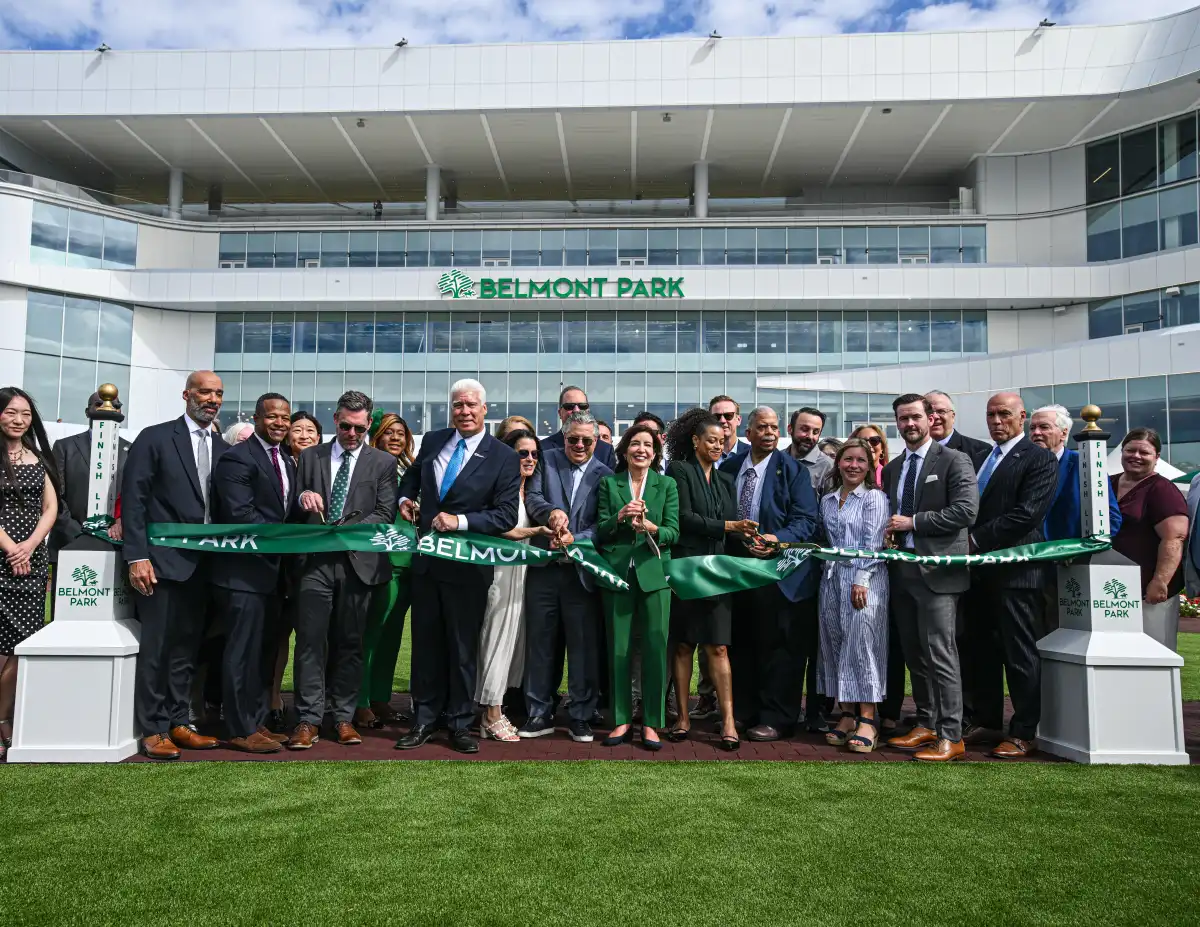
Opening Day began bright and early on the morning of Sept. 18, roughly 3 hours before post time of the first race, with a ribbon-cutting ceremony in the newly transformed paddock led by Gov. Kathy Hochul. She hailed it at the dawn of a new era in horse racing not just for New York but also for the country. Belmont Park will serve as the primary home for the New York Racing Association, one of the nation’s largest thoroughbred racing circuits; it replaces the now-shuttered Aqueduct Racetrack in Queens and will race year-round, except for the six-week Saratoga meet every summer.
As Hochul noted, it gives New York two premier racetracks: Saratoga, the oldest continuously operating racing landmark in the country; and a futuristic, 21st-century Belmont Park ready to deliver championship racing and world-class amenities throughout the year. The governor said the state “made the bet” on Belmont “because we saw the enormous economic potential, which is what is behind everything we do.”
“We set out to build an international racing hub that could double as a concert and entertainment space, a versatile venue that belongs not to racing fans, just racing fans alone, but to the entire community,” the governor said. “This is so important for our elected officials here as well, a place that’s welcoming to everyone, a venue that’ll generate over $155 million in annual economic impact and sustain thousands of permanent jobs right here on Long Island.”
Belmont Park ‘symbolizes victory,’ NYRA chair says
The new Belmont Park was the brainchild, in many respects of NYRA Chairman and CEO Marc Holliday, whom, according to the governor, had pitched her the idea years earlier with a rendering video he provided.
After long negotiations, Hochul and the legislature signed off in 2023 on a $455 million loan to build the new Belmont on the site of the former; NYRA will repay the state through a share of the revenue it earns from the Resorts World New York City casino, located in Queens in the former Aqueduct grandstand.
Holliday said the new Belmont “symbolizes victory.”
“Standing behind me isn’t just a new building; it’s a monument to what happens when vision, partnership, and determination unite to push boundaries and build something that really moves the heart,” he told the crowd at the ribbon-cutting. “This grandstand was designed to celebrate the magic of openness and transparency, letting in natural light to flood every corner of this facility, bringing fans, jockeys, and these incredible equine athletes together, closer than ever before.”
More than 3,700 union construction workers labored over the past 2 1/2 years to bring down the old quarter-mile Belmont Park grandstand, build the new one, renovate the massive racing surfaces, and create more than two dozen acres of greenspace, including an expanded backyard and the infield, which the public will be able to access for the first time in Belmont’s more than 120 years of existence.

“The fact that we’ve been able to pull off this monumental achievement in only 11 months from the time that we actually started the groundbreaking,” Building and Construction Trades Council of Nassau and Suffolk Counties President Matthew Aracich, “that is something that only happens when you get the cooperation of everybody.”
The new grandstand, shimmering in glass and white tile, is a sleek, five-story, 300,000 sq. foot facility, climate-controlled to keep fans comfortable in all weather. The first two floors are open for now while construction on the upper floors continues until an expected finish next spring.
It overlooks completely rebuilt racing surfaces at Belmont, including the 1 1/2 mile dirt main track — the largest in North America — along with two lush new turf courses and, within them, a new 1 mile Tapeta synthetic track that NYRA will use for winter racing and to run races take off the grass during inclement weather.


Behind the grandstand is a saddling paddock that’s 50% larger than the paddock it replaced, and redesigned to bring horse racing fans closer to the horses and jockeys as they race.
Capacity at the new Belmont has been capped at 6,000 fans for the first three days of racing this weekend; afterward, the capacity will be capped at 4,000 every race day for the remainder of the fall meet, which runs through early December. When fully completed, the new Belmont Park, on big race days such as the Belmont Stakes and the Breeders’ Cup World Championships (which will host in fall 2027) will have the ability to accommodate up to 50,000 people.
The new track filled up quickly with excited patrons by the time the 10 horses loaded into the gate for the first race on the new turf, a 1 1/4 mile contest. The crowd roared as the horses sprung from the gate and watched the contest largely from the massive infield jumbotron.
Roughly two minutes later, a filly named Lisa Joy, ridden by Antonio Fresu, stuck her nose in front on the wire in an exciting photo finish. The longshot paid $26.72 to win.
The first two floors of the grandstand offer fans a number of modern amenities and high-quality dining operations, with menus crafted by NYRA’s executive chef, Marc Forgione. The restaurants and bars include Big Red’s, a sports bar on the western end named for Secretariat, the famous 1973 Triple Crown champion who won the Belmont Stakes by 31 lengths in record time; the Homestretch Market food court; and Silks and the Trackside Lounge, two upscale clubs.
The ribbon-cutting was one of several races leading up to the main event on the inaugural card, the Grade 1, $1 million Jockey Club Gold Cup, the scheduled fifth race at 4:14 p.m., in which international racing star and defending Breeders’ Cup Classic winner Forever Young is the heavy favorite.


