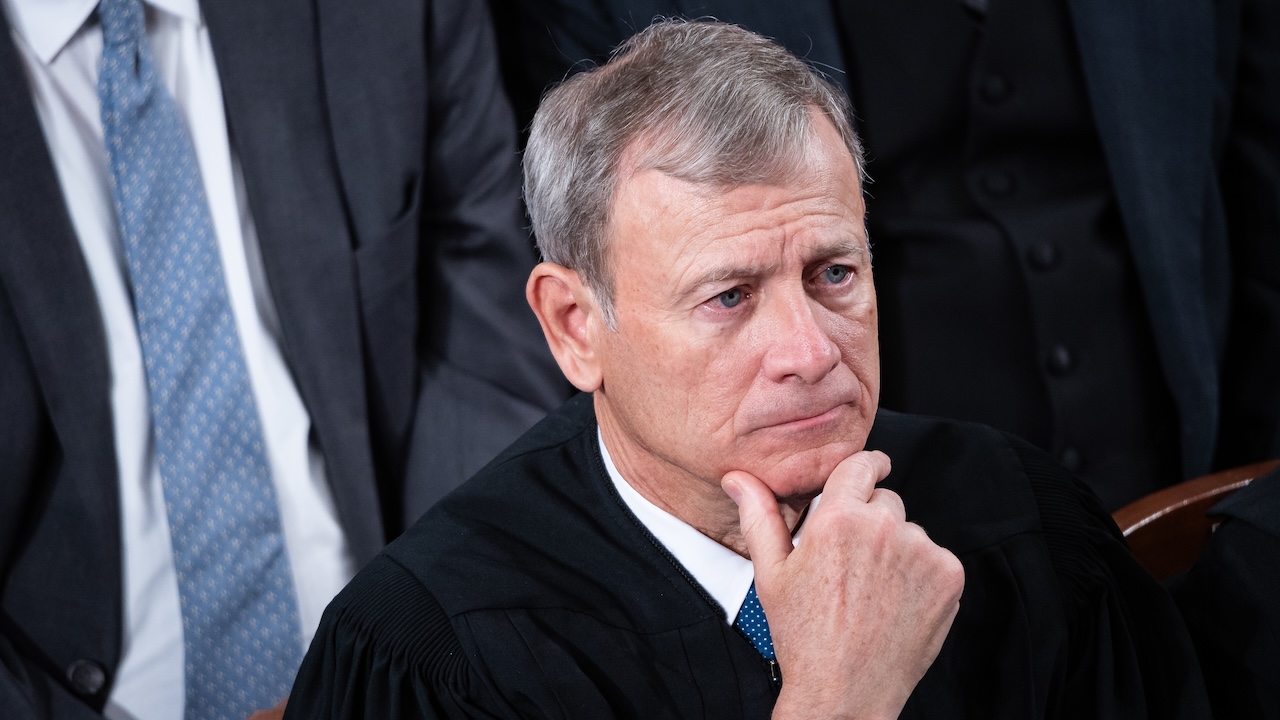
Supreme Court Chief Justice John Roberts looks on during the State of the Union address in the House chamber at the U.S. Capitol in Washington, on Feb. 24, 2026 (Francis Chung/POLITICO via AP Images).
The Trump administration has asked the U.S. Supreme Court to step in and halt an “indefensible order” so the executive branch can ensure the “integrity of upcoming elections” with a “modified” system for “voter verification” while an appeal proceeds.
The DOJ’s stay application on Tuesday, once again seeking swift interim relief from the conservative majority, comes days after the U.S. Court of Appeals for the District of Columbia Circuit issued a 2-1 decision against the Trump administration and its changes to the Systematic Alien Verification for Entitlements (SAVE) database.
Chief Justice John Roberts, as the president’s ballroom controversy illustrated, is the circuit justice assigned to handle stay applications like this one from the D.C. Circuit.
There, the appellate court refused to stay U.S. District Judge Sparkle L. Sooknanan’s summary judgment ruling, a lengthy June decision that led to at least one impeachment push against the Joe Biden-appointed jurist.
Love true crime? Sign up for our newsletter, The Law&Crime Docket, to get the latest real-life crime stories delivered right to your inbox.
The D.C. Circuit majority left the summary judgment order untouched and denied a stay pending appeal, explaining that the government “forfeited arguments” that it later asked the court to credit.
“Only after the district court had already granted summary judgment for plaintiffs did the government raise what are now its central arguments regarding plaintiffs’ Social Security Act claim. When the government first aired those forfeited arguments in moving for a stay pending appeal, the district court declined to consider them in that expedited posture but expressly invited the government to submit a post-judgment motion to excuse the forfeiture and receive full consideration of the late-raised arguments,” said the majority, in a per curiam order. “The government did not do so, instead coming straight to our court and seeking a stay pending appeal based in significant part on the forfeited arguments.”
“We decline to overlook the forfeiture for purposes of the government’s stay motion; and at any rate, even considering the forfeited arguments as they are presented in the necessarily constrained context of an expedited stay motion, we cannot conclude that the government has made the requisite strong showing of a likelihood of success,” the D.C. Circuit said.
Sooknanan held that the government’s “establishment of the SAVE modified system and the notices that followed [were] unlawful in several respects,” noting violations of a “prohibition in the Social Security Act against the disclosure of Social Security numbers and other related SSA records.”
Secondly, the judge said, the modifications “violate both substantive and procedural protections in the Privacy Act, which prevent the non-consensual disclosure of certain information.”
As a result, she vacated and set aside the “2025 SAVE modified system and the related notices” from the Social Security Administration and DHS in their entirety.
U.S. Circuit Judge Gregory Katsas, the lone appointee of President Donald Trump on the panel, was the only jurist who would have issued a stay pending appeal.
Katsas, without addressing standing, said that “several considerations support excusing the forfeiture in the quite unusual circumstances presented here,” the first being that the case “involves the ongoing administration of an important federal program mandated by Congress to facilitate eligibility determinations for voting and a wide range of federal benefits.”
Unsurprisingly, the Trump administration’s ensuing stay application at the Supreme Court mentioned Katsas’ name 14 times and noted he “agreed with the government on the merits arguments.”
But the government went a step further than Katsas did in asserting that the League of Women Voters and the Electronic Privacy Information Center lack standing to sue, and that Sooknanan “universally” issued an “indefensible order” in the groups’ favor.
“The district court’s order warrants review because it universally vacates an important governmental policy—the improvement of a system that has processed millions of citizenship-verification requests every week and that is used for purposes ranging from maintaining voter rolls to ensuring that ineligible aliens do not wrongly receive federal benefits,” the application said. “The federal government, the States, and the public face irreparable harm from the court’s sudden upending of the updated system and from being required to return to an older, more cumbersome, and less reliable version of the system. Those harms dwarf any harms faced by respondents, who cannot show even an Article III injury, much less irreparable injury.”
Looking ahead, the administration will need the votes of five justices to win the stay pending appeal it seeks.
The post Trump DOJ tells Chief Justice Roberts that a judge’s ‘indefensible order’ is what actually ‘threatens the integrity of upcoming elections’ first appeared on Law & Crime.