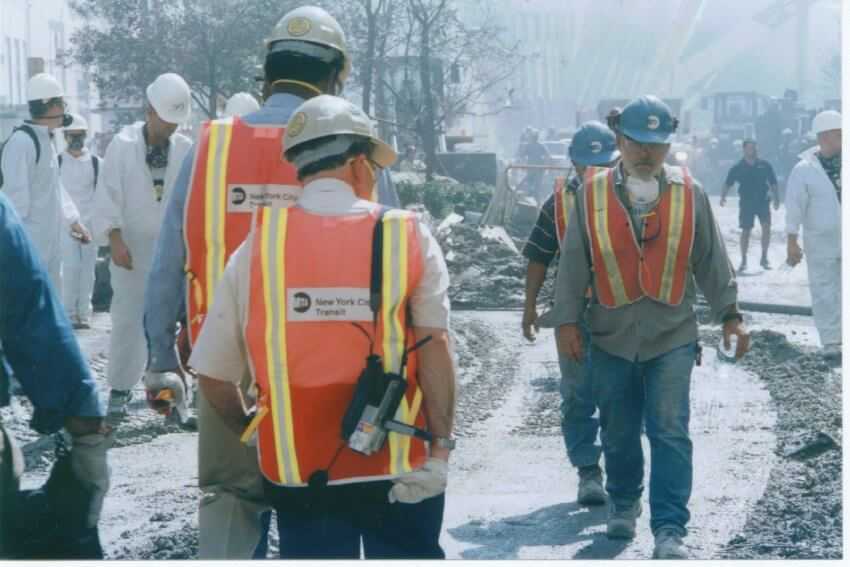
New York City will make more than 170,000 pages of Sept. 11 records public on Tuesday — opening a vast trove of records that sheds new light on how officials grappled with air-quality risks, health warnings and potential liability in the months after the 2001 World Trade Center attacks.
By launching the 9/11 portal and beginning to release the records just days before the 25th anniversary of the terrorist attacks, Mayor Zohran Mamdani’s administration is settling two Freedom of Information Law lawsuits over access to the material, according to a Law Department official who briefed reporters Monday.
The settlement sets up a yearlong process for further disclosures, with the parties agreeing on search terms for millions more documents and monthly meetings over the next 12 months. The city also agreed to pay attorneys’ fees.
“The very least our city owes the families, survivors and first responders whose lives were forever changed by the September 11th attacks is transparency and accountability,” Mamdani said in a statement ahead of the portal going live.
“For too long, New Yorkers have had to fight for access to records that should have been available to them in the first place,” he added.
Among the records the city is highlighting in the first drop is an unsigned May 2002 cleanup note saying the word “risk” would not be used in letters connected to a Lower Manhattan cleanup initiative because doing so would “defeat the purpose of creating public confidence.”
A 9/11 portal after years of records fights
The searchable September 11th Document Portal is set to go live Tuesday morning, three days before the 25th anniversary of the attacks.
In the months after the World Trade Center collapsed, city and federal officials reassured New Yorkers about air quality as residents, office workers and first responders returned downtown. Questions about what government officials knew about contaminants — and what information they had when those assurances were given — have persisted for decades.
As of Aug. 31, the September 11th Victim Compensation Fund had received 9,780 deceased claims, which the fund defines as claims involving people who died of causes directly related to an eligible 9/11-related condition.
The first release is centered on more than 20,000 documents found in August 2025 in 68 boxes of Department of Environmental Protection records. It also includes Giuliani administration material kept by the city archives, records concerning the collapse of 7 World Trade Center, and records from several other city agencies. More material is expected to be posted over the next year.
The records fight included two Freedom of Information Law lawsuits seeking access to the material. One was brought by 9/11 Health Watch, which had filed FOIL requests seeking city risk assessments, communications among city and federal officials and records showing the basis for public assurances about conditions in Lower Manhattan.
A Law Department official said both cases sought essentially the same kinds of records now being released through the portal. The settlement resolves both cases and calls for agreed search terms and monthly meetings over the next 12 months as additional records are released, the official said.
What the records show
The three documents highlighted by the city and reviewed by amNewYork address health concerns, cleanup decisions, potential legal exposure and public messaging in the months after the attacks.
Among them is a one-page note dated May 16, 2002, titled “Clean Up Initiative.” The document does not identify its writer or intended recipient.
The note describes discussions over a cleanup effort involving the EPA, FEMA and city agencies. The writer says the Law Department wanted testing conducted before work was done but expresses concern that FEMA could balk at paying for a broad cleanup if testing first showed conditions were fine.
It also records a discussion about wording in letters connected to the cleanup effort. The writer says they told Steve Haggerty, identified in the document as working for Brad Gair, the FEMA official who led the federal recovery effort in New York, that “your letter spoke on behalf of the City” and included the Health Department and Economic Development.
“I stressed that we would not use the word ‘risk’ in any letters as it would defeat the purpose of creating public confidence,” the writer said.
The document refers to a “Conversation with Kathy Callahan,” who appears to be Kathleen Callahan, an EPA official involved in New York City response and recovery operations after the attacks.
The document does not say exactly what letters were being discussed or who had authority over their wording. But it shows that someone involved in the cleanup effort was explicitly considering how the word “risk” could affect public confidence while officials were working out how testing and cleanup would proceed.
The New York Times, which was given advance access to a broader set of the records, reported that the files include environmental testing showing asbestos and other carcinogenic contaminants in parts of Lower Manhattan, with some measurements above acceptable limits. The Times reported that a draft DEP document identified locations where some dust samples exceeded asbestos limits in the days after Sept. 11, while another review found benzene spikes near the World Trade Center site and increased asbestos concentrations at the Fresh Kills landfill.
The Times also reported that asbestos was still being detected at 15 John St. in July 2002, about 10 months after the attacks, and that other records showed asbestos and additional contaminants in dust and air elsewhere in Lower Manhattan, sometimes above acceptable limits.

Trade Center in New York on Sept. 11, 2001.REUTERS/Shannon Stapleton
Concerns about indoor air and the city’s public guidance had reached senior Bloomberg administration officials months earlier.
A Feb. 28, 2002, memo seen by amNewYork from Ester Fuchs, then a special adviser in the Mayor’s Office, summarized concerns raised by U.S. Rep. Jerrold Nadler and was sent to officials including Corporation Counsel Michael Cardozo, Health Commissioner Thomas Frieden, Deputy Mayor Marc Shaw and press secretary Ed Skyler.
The memo said there was at least a low level of asbestos in dust in many Lower Manhattan buildings and noted that the Health Department had advised residents to clean with wet mops and rags. Nadler argued that because asbestos cleanup generally required licensed professionals, the city could be telling residents to clean contaminated material themselves.
“If Nadler’s concerns are justified, we are not informing people of the real health risks in lower Manhattan,” Fuchs wrote. She warned of potential public relations problems and lawsuits and recommended that the city reconsider the wet-mop guidance and ask FEMA to fund indoor cleanup.
The memo also presented the Health Department’s position. Testing at a sample of residential buildings had not found elevated asbestos in indoor air, though low levels had been found in some dust. Frieden described the available data as reassuring while acknowledging that conclusive scientific knowledge about some potential long-term hazards was not yet available.
Fuchs also relayed Nadler’s allegation that on the same day then-EPA Administrator Christine Todd Whitman reassured New Yorkers about air and water quality, the agency had withheld test results showing higher-than-acceptable levels of asbestos and other contaminants.
The third highlighted document shows the city considering its potential legal exposure within weeks of the attacks.
The previously reported Harding memo said the Law Department estimated about 35,000 potential plaintiffs and projected that 10,000 could file claims.
Among the possible cases it identified were allegations that health advisories caused people to return downtown too soon and suffer toxic exposure, that rescue workers lacked adequate respirators and that cleanup was inadequate.
The memo also examined possible ways to limit the city’s liability, including federal indemnification, and contemplated toxic tort cases that could emerge years or decades later.
A Law Department official said Monday that the records reviewed so far indicate people in positions of authority knew there were air-quality problems downtown while the general public did not have access to records reflecting those concerns.
Millions of records were elsewhere
The records becoming public Tuesday represent only part of what the city now has to review.
The 68 DEP boxes became a focal point of the disclosure fight after years of questions about whether the city had fully searched for records from the aftermath of the attacks. The city’s FAQ for the portal says DEP had preserved the material but that the records were moved over time, including into long-term storage, and were not located during earlier FOIL searches.
The Harding memo surfaced by a different route. According to the city, litigants found a copy in the archives of a deceased journalist and provided enough information for the Law Department to locate its own copy in city archives in February 2026.
Millions more records had been outside the Law Department altogether.
A Law Department official said millions of documents gathered after Sept. 11 were sent to the World Trade Center Captive Insurance Company as part of the effort to defend the city against litigation stemming from the attacks.
The Law Department did not retain copies of that large collection, the official said. The Mamdani administration requested the records back after taking office and received them within the past several months.
Asked why it had taken so long for the records to be sought from the Captive, the official said he could not speak to the delay. The official also said the Captive itself is not subject to FOIL.
Those millions of records are now being reviewed, with additional releases expected over the next 12 months.
A Law Department official said the administration intends to release all of the records it has, with limited exceptions for personally identifying information and some security assessments of buildings in Lower Manhattan.
The accountability inquiry continues
The portal does not resolve the broader question of who knew what about conditions downtown and why records remained unavailable for so long.
The City Council in 2025 mandated a two-year Department of Investigation inquiry into the city’s handling of post-9/11 air-quality information. Earlier this year, DOI told the Council it needed $4 million to hire an outside firm to help locate and review records. Council members pointed to the discovery of the DEP boxes as evidence that previous searches had fallen short.
The final city budget this year included that $4 million, along with $34.2 million for the document portal and review effort.
A Law Department official said the $34 million was developed as a worst-case estimate before the litigation was settled and that working with 9/11 Health Watch and other parties on targeted search terms could reduce the eventual cost.
The official said the DOI investigation is running on a parallel track and is aimed specifically at determining who knew what, when and why particular decisions were made. Records identified through the portal review will also be made available to investigators.
Corporation Counsel Steven Banks, in a written introduction to the portal, acknowledged the long delay in making the records accessible.
“For too long, information about the aftermath of September 11th has not been provided to the public,” Banks wrote.
“Transparency and public access to government records are essential to understanding the City’s actions, decisions, and experiences during this tragic period in our city’s history.”
