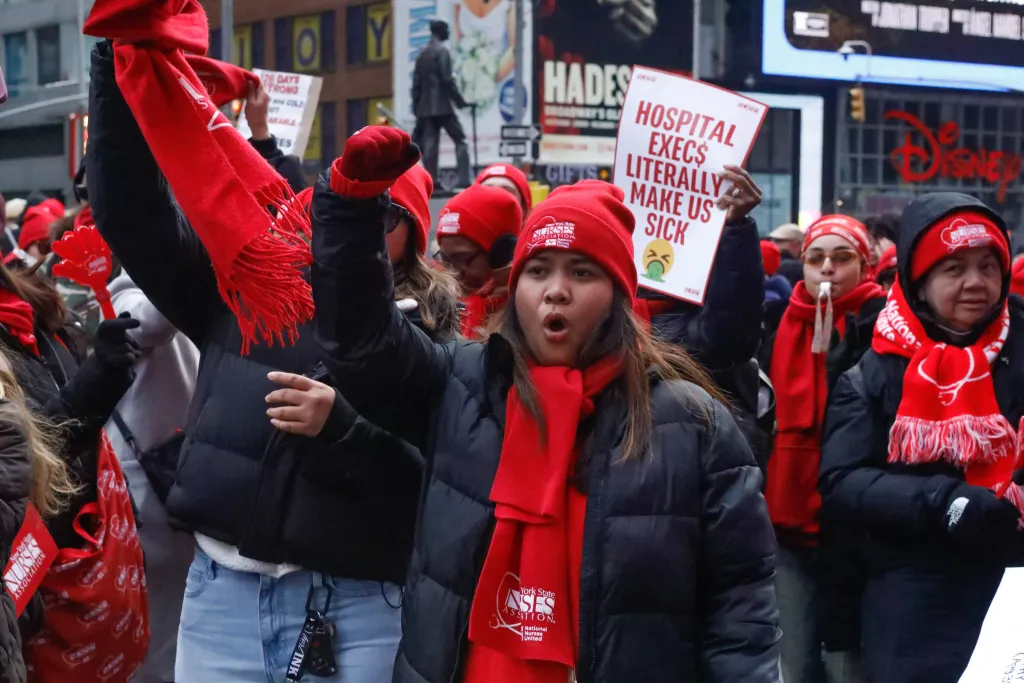
Organized labor in New York City has been mightily active so far this decade, and the first half of 2026 was no exception. Nurses, public defenders, hotel workers and college faculty all walked off the job this summer to historic effect, winning substantial contract improvements.
But, while union advocates may have reason to pat themselves on the back, the momentum has not been enough to reverse New York’s decades-long decline in overall unionization rates, according to the latest annual report by the CUNY School of Labor and Urban Studies.
The share of the unionized workforce in the city has remained flat despite an uptick in what researchers describe as “highly visible union activity,” such as the historic nurses strike this past winter.
But there are some bright spots: New York ranks first in union density among the nation’s largest states; it is second overall only to Hawaii, which has a much smaller population. Between 2025 and 2026, public-sector union density in both New York City and State was roughly double the national average.
In all, New York has more union members — 1.81 million — than any state other than California, the nation’s most populous.

Ruth Milkman, a co-author of the report and chair of CUNY’s graduate labor studies department, said in an interview that New York is still a stronghold of organized labor, and reiterated that recent organizing, successful strikes and strong public support for unions bode well for the city’s labor movement.
But that activity has not reached the scale needed to reverse a longer-term decline in the share of workers who are union members, the report found, echoing its findings from recent years.
The threats to workers across the nation and in New York are overwhelming, from artificial intelligence and the consolidation of large corporations, to the Trump administration’s gutting of the federal workforce and its culling of the National Labor Relations Board.
“So the fact that New York’s numbers are staying flat, it’s actually an achievement,” said Milkman.
Milkman’s research team completes its annual report using Census data from the U.S. Current Population Survey of New York City residents. The New York City Central Labor Council, the city federation of unions, has disagreed with the report’s methodology and conclusions in the past, claiming that it does not account for workers employed in the city who live in its suburbs and in neighboring states.
Healthcare and education are two of the most unionized sectors in New York City, at 28% and 18.6% respectively, according to the report. And this year, workers in those sectors showed their might: A 39-day walkout this past winter resulted in raises and improved nurse-to-patient ratios for 15,000 nurses across three private hospital systems.
That strike by the New York State Nurses Association was the largest and longest of its kind in New York City history. Meanwhile, non-tenure track faculty at New York University won their first-ever contract following a two-day strike in April, and more than two years after they unionized with the United Auto Workers.

This year’s report also zeroes in on Mayor Zohran Mamdani’s unprecedented focus on boosting worker organizing in the private sector and his administration’s efforts to crack down on labor law violations. Last month, the city Department of Consumer and Worker Protection announced a new partnership with the Manhattan District Attorney’s office that will make it easier for both offices to investigate wage theft and other crimes.
However, the researchers cautioned, Mamdani’s “biggest challenge will come later in 2026, when the municipal labor contracts expire and new ones will be negotiated, affecting hundreds of thousands of workers.”
The city’s limited control over its budget resources “will make this an especially daunting task,” the report notes, adding that Mamdani’s success will depend on the strength of his relationships with Gov. Kathy Hochul and the state legislature.
Our nonprofit newsroom relies on donations from readers to sustain our local reporting and keep it free for all New Yorkers. Donate to THE CITY today.
The post Does New York’s Labor Momentum Measure Up? appeared first on The City Reporter.
