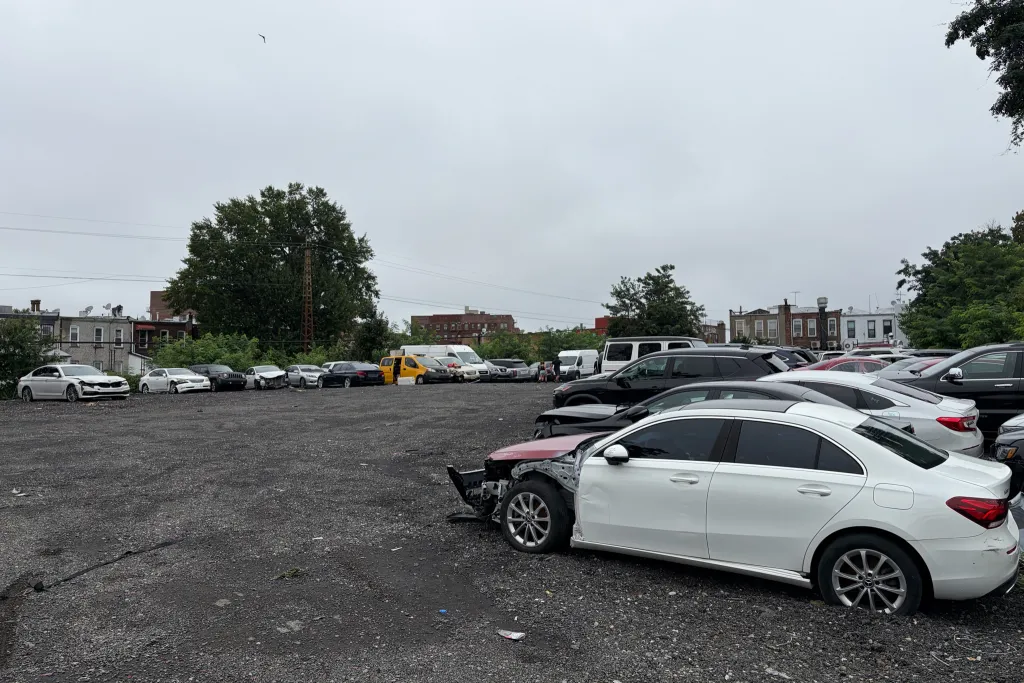
The city Landmarks Preservation Commission is evaluating a new proposal to protect the site of a 19th century burial ground for Black New Yorkers that was turned into a parking lot by an anonymous property developer.
Last week the Elmhurst History and Cemeteries Preservation Society and the pastor of St. Mark African Methodist Episcopal Church filed a “request for evaluation” asking the commission to designate the property a landmark, which would greatly restrict development there.
“The right thing needs to be done to protect and let the cemetery finally prevail and be respected. The New York City Landmarks Preservation Commission must act to landmark this site,” the group asserted in documents obtained by The City Reporter via a Freedom of Information request.
The application comes as St. Mark’s pastor, Rev. Kimberly Detherage, and Queens Borough President Donovan Richards Jr., have called on the city to purchase the property and turn it into a memorial to honor those who are buried there, including as many as 300 enslaved and formerly enslaved residents of a 19th century Black enclave known as Newtown.
Mamdani Mum on Cemetery
On Thursday, Matthew Rauschenbach, a spokesperson for Mayor Zohran Mamdani, declined to address the call to buy the lot, but acknowledged the site’s historical significance.
“We understand the concerns about this site, which reflects an important and complex period of Black history in this city following the abolition of slavery in New York State in 1827,” he said. “We have heard the calls to formally designate the site as a New York City landmark. The LPC is an independent entity, and I would refer you to them for next steps in this important process.”

The cemetery at what is now 47-11 90th St. is believed to date to 1818, nine years before slavery was abolished in New York. In 1828, a year after New York’s emancipation went into effect, a group of freed slaves formed the United African Society and purchased the property. The group later became the St. Marks AME, which sold the property in the 1930s and moved to Jackson Heights, but currently maintains some stewardship over the burial ground.
The most recent owner, a limited liability corporation called 90 Queens LLC, tried building luxury condos there but in 2011the project was put on hold when workers excavating the site unearthed an iron coffin containing the remains of a free-born Black woman who had likely died of smallpox. Subsequent archaeological exploration of the site turned up the remains of 10 more individuals who were disinterred and remain in secure storage offsite.
The owner walked away from the condo project and last year paved over the site to use it as a parking lot. Last month The City Reporter visited the site and found dozens of junked vehicles there, including several that were brought there by a vendor hired by the NYPD to tow abandoned vehicles off city streets.

The Department of Buildings earlier this year declared the parking lot illegal, and ordered it shut down by Nov. 30. In 2022, a bank filed a lawsuit to foreclose on the property after it alleged 90 Queens LLC had failed to make any mortgage payments. The bank later sold the loan to another entity, 90 Street Realty LLC, and the judge handling the foreclosure case appointed a referee to dispose of the property. The referee last month announced his intention to sell the site.
‘Glossed Over’
The property, however, is subject to the state Unmarked Burial Site Protection Act, which requires the owners to properly address burial sites before developing their property.
In their request for a landmark designation, the Elmhurst historical group and Rev. Detherage noted the existence of two other African burial grounds that have been landmarked by the LPC: the Jacob Rodman Drake Park and Enslaved People’s Burial Ground in Hunts Point, the Bronx, and the Frederick Douglass Memorial Park in Oakwood Heights, Staten Island.
“Why was this not the case for the African Methodist Episcopal Church Cemetery-Newtown African American Burial Ground?” they asked. “How could this have just been glossed over? The Landmarks Preservation Commission should have acted back then which would have changed the terrible and disrespectful events that followed.”
MORE: Pastor Calls for Remains of Freed Slaves to Be Reinterred, Urges City to Landmark Site
Landmarks spokesperson Courtney Metakis confirmed that the agency had received the group’s request on Aug. 28, which triggered an evaluation to see if the site is eligible for landmark status.
“If LPC determines that the landmark suggested ‘may merit’ consideration, it will be added to the agency’s survey list and considered in the context of agency priorities,” she wrote in an email.
The commission, which is overseen by an 11-member board of mayoral appointees, considers a variety of factors, including a site’s cultural significance and “how it aligns with agency policies.” The commission has adopted what it calls an “Equity Framework,” seeking to prioritize “designations that represent New York City’s diversity or are located in areas of the City less represented by landmarks.”
While there are landmarked properties all over Manhattan and along much of Brooklyn’s waterfront, there are almost no landmarked properties in Elmhurst, with the exception of the architecturally impressive Newtown High School and two nearby churches that are hundreds of years old: the Reformed Dutch Church (1831) and Old Saint James Episcopal parish hall (1735).
Our nonprofit newsroom relies on donations from readers to sustain our local reporting and keep it free for all New Yorkers. Donate to THE CITY today.
The post New Push to Landmark Paved-Over Queens African Burial Ground appeared first on The City Reporter.
