After years of advocacy from street vendors, New York City’s Department of Consumer and Worker Protection has begun accepting new applications for merchandise vending licenses for the first time in decades. But many vendors vying for one of the 10,500 new licenses say they worry the approval process could keep them waiting for years more.
The Mamdani administration has so far been vague about some key details of the process, vendors and their advocates say, even as the license expansion is meant to legitimize sellers who have for years worked in the shadows and boost city revenue through taxes and fees.
“As much as we are excited and thrilled that this change is happening, we are very troubled by the proposals being discussed today,” Mohamed Attia, managing director of the advocacy organization Street Vendor Project, said during a DCWP hearing on proposed permitting rules last month. The proposal, he added, “doesn’t ensure that currently operating vendors will get priority receiving the license.”
In accordance with a law the City Council passed earlier this year to expand vendor licensing, DCWP will first process and prioritize applications submitted by any of the roughly 11,000 merchandise sellers already registered on a 2016 waitlist. That leaves out anyone who missed the registration window that lasted only about a month a decade ago, along with vendors who entered the trade after that window closed.
For those sellers, DCWP has proposed they simply self-certify they’re currently vending to receive secondary priority. But the agency has not yet elaborated on what the certification process would entail in the rules it has floated — only that it should be “conducted in a form and manner as determined by the commissioner.”
Affected vendors and their advocates say they’re concerned officials may not be able to distinguish between established sellers and applicants falsely claiming to be so, if the city doesn’t require evidence up front.
“Currently operating vendors will be gambling. They would be playing the lottery to get a license and formalize their business,” Attia said. “And if you don’t win the lottery and don’t get the license right away, you’ll be placed on a waiting list and wait again for an unknown number of years until a license becomes available.”
In all, roughly 900 of the city’s 2,400 merchandise vendors have been operating without a license in recent years, according to a 2024 estimate by the Immigration Research Initiative, after a 1979 law capped the number of available licenses at 853 for decades. The vast majority of local street vendors are immigrants and say vending is their primary source of income.

Lawmaker Concerned About Proposed Rules
Vendor leaders say all applicants seeking priority should be required to submit at least one form of documentation to show they’ve already been vending. That could include a sales tax certificate, vending-related summonses, wholesale receipts, photos or letters from customers and local officials.
City Councilmember Pierina Sanchez (D-Bronx), who sponsored the licensing bill and for more than two years pushed for its passage, said she shares those concerns.
“Reforms only matter if the people they were designed to serve can actually benefit,” Sanchez, a granddaughter and daughter of street vendors, wrote in a comment to DCWP on the proposed rules. “That is why I am concerned that relying too heavily on self-certification of prior vending activity could allow longtime vendors to be pushed aside.”
DCWP spokesperson Stephany Vasquez Sanchez said the department is reviewing public comments on the proposed rules and has not determined a timeline for adopting them. She declined to comment on vendors’ concerns about the self-certification process, citing the ongoing rulemaking process.
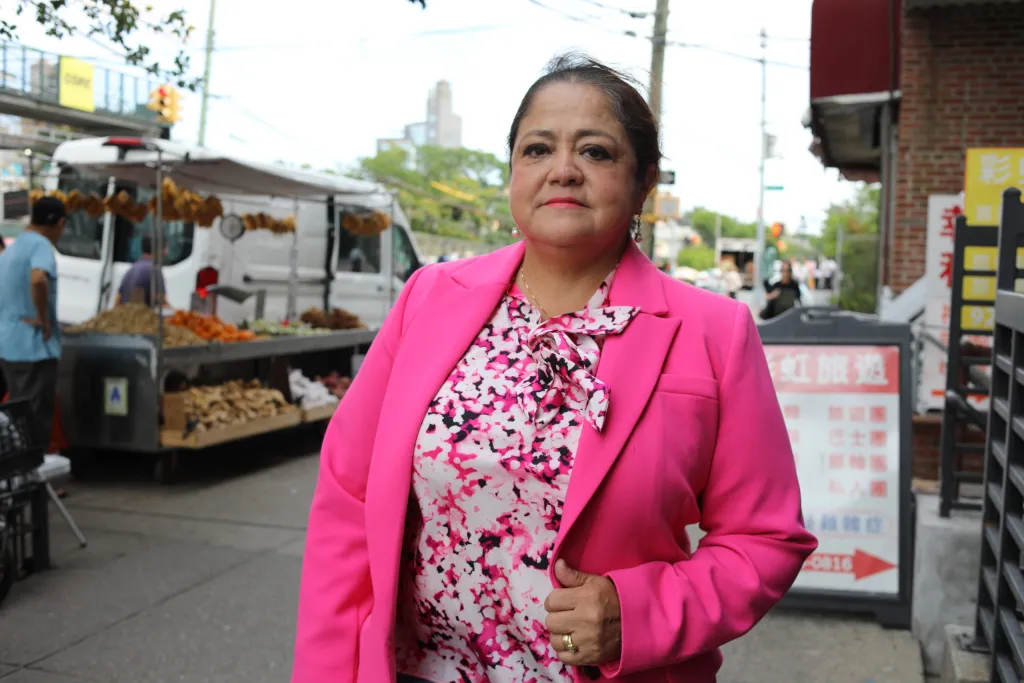
“I do not agree that someone should be able to merely say, ‘Yes, I have been a street vendor for a long time,’ and that’s it,” said Rosario Troncoso, president of the Street Vendor Association at Queens’ Corona Plaza, once a bustling street vending hub before city crackdowns in 2023 drove away many merchants.
The 53-year-old started selling accessories like embroidered bags and backpacks six years ago after losing her job as a housekeeper during the COVID-19 pandemic. She missed out on the waiting list that was briefly open four years earlier and that’s now prioritized for license processing.
“It would be good if they required evidence, because it’d make the process more equitable for everyone, more regulated,” Troncoso added.

‘I Would Feel Defrauded’
Luz Uruchima’s headaches began in May 2024, a few days after she returned from Acapulco, her hometown in Mexico, where she had gone to bury her mother.
“When I went out to work that Saturday, the police came. Eight police officers arrived at my workplace to give me a $1,000 ticket,” said Uruchima, who sells keychains, cosmetics, perfumes and hats in Sunset Park, Brooklyn. “Every weekend they arrived and gave me a ticket: $1000, $1000 and another $1000.” In total, she said, she’s received about a dozen tickets in this amount over that period.
Uruchima’s story is a familiar reality for many street vendors who operate without a license. So far this year alone, vendors have received at least 1,788 civil and 274 criminal tickets for unlicensed merchandise sales, according to city data, with fines ranging from $250 to $1,000 per violation.
“My children and my husband tell me, ‘Do not go out to vend anymore. Do not put yourself through that situation,’” Uruchima recalled in Spanish. “Nevertheless, for me, it is something in my heart — as a vendor, I feel it and I like it.”

Uruchima said she’s been vending for two decades, but did not feel she needed a license until the last few years, when vending enforcement began to escalate under the Adams administration amid complaints from brick-and-mortar business owners about the unsanctioned competition. By then, it was too late for her to join the 2016 waitlist for a license.
Like many of the city’s street vendors, she has marched to City Hall and attended many rallies over the last few years to advocate for reforms including new licenses. At the August DCWP hearing, she pleaded with the agency to require evidence from sellers seeking secondary priority: “For the waiting list to be open to all of those wanting to apply, it is not clear for those of us who have been waiting for many years that we’d be able to get our licenses.”
“I would feel defrauded,” Uruchima told The City Reporter after the hearing, imagining a future where she can’t access one of the new licenses. “At the end of the day, my goal would be for us to obtain those licenses — not only me, but for the many people who do not have one to be able to obtain one.”

What Else Can We Do?’
Troncoso, the Corona Plaza vendor leader, acknowledged some merchants may not have sufficient evidence to present to DCWP.
“But we also have to understand that many people have been waiting for these licenses,” she said. “That is precisely why we are trying to educate people so they understand the need to obtain certain documents.”
While the city formalized the Corona Plaza market as “the first-ever regulated community vending area” in 2023, allowing unlicensed vendors to keep operating in the square, Troncoso said the market has not attracted as many sales as its vendors had hoped. That’s in part due to the market’s hours from 9 a.m. to 8 p.m five days a week, which vendors have said cause them to lose out on early-morning and late-night business from their blue-collar clientele.
The need for additional licenses has become especially urgent for vendors in the plaza in recent months as foot traffic and sales have slowed with the threat of immigration enforcement in the majority-Latino neighborhood, Troncoso said.
“I still am not confident — and do not assume — that I will be able to obtain a license,” she said. “We will keep waiting to see what happens, because what else can we do?”
She deliberated for a moment about DCWP’s proposed rules before adding: “In the end, we have to accept things as they come. And if we have to keep fighting, then we will.”
Our nonprofit newsroom relies on donations from readers to sustain our local reporting and keep it free for all New Yorkers. Donate to THE CITY today.
The post NYC Street Vendors Won More Licenses. Murky Rules Could Make Them Wait Years for One. appeared first on The City Reporter.
