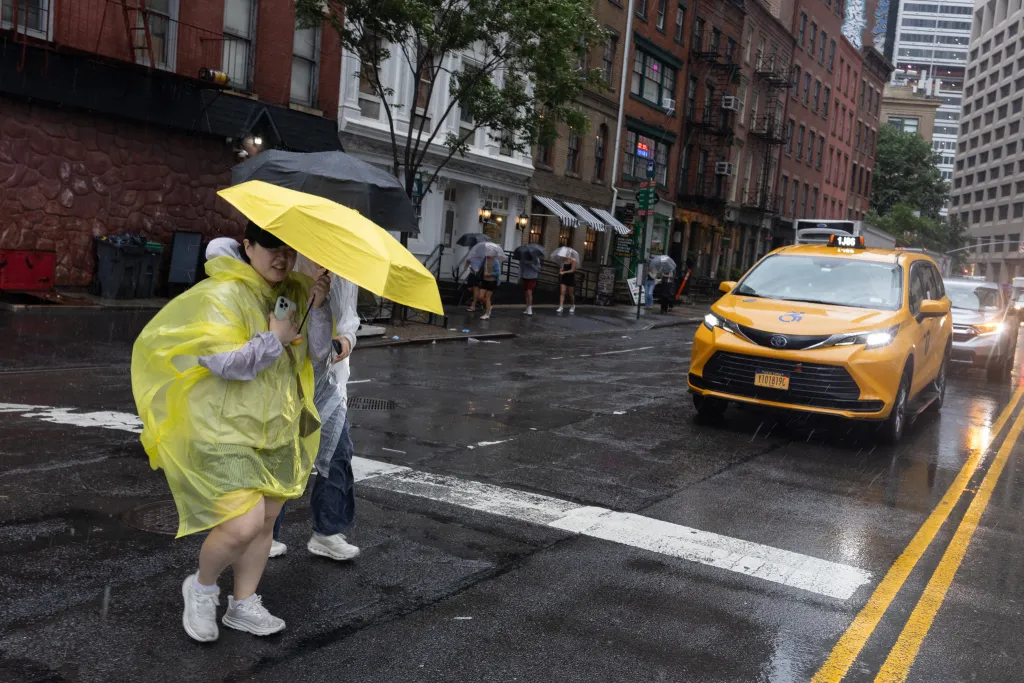
The remnants of Hurricane Ida barreled through New York City five years ago, dumping unprecedented amounts of rain on the city and resulting in 13 New Yorkers’ deaths. The storm, which served as a wake-up call about the safety risks of extreme rain, still looms large today, having marked a shift in how city officials and residents recognized inland flooding as an urgent problem.
“Ida is precisely the day we stopped primarily worrying about coastal flooding and started worrying about stormwater,” said Rohit Aggarwala, the city’s former chief climate officer and environmental protection commissioner.
Ida was the city’s deadliest since 2012’s Superstorm Sandy. Most of the New Yorkers who died drowned in their basement apartments in Queens, and more than 100 families were displaced from their homes.
In the time since, city government has improved the way it communicates with residents about potential flooding, expanded efforts to handle vast quantities of water around the boroughs and taken steps toward making basement apartments safer. Local communities have also played a role in preparing for and responding to deluges, which have hit New York regularly since Ida, including several this summer.
But the concrete jungle is far from transforming into a sponge. “There’s been a lot of progress, but there’s always more to do,” said Queens Borough President Donovan Richards.

‘Should We Even Go Out?’
New Yorkers have in recent years become familiar with the effects of extreme rain. Manhole covers pop; water gurgles up through sewer grates or jumps a curb and spills into windows and doors; sewer backups lead to water and human waste coming out of toilets and bathtub faucets; travelers traverse rushing water on streets and dodge waterfalls in subway stations.
Sam Wu, a homeowner in Flushing’s Kissena Park, said he lost two cars to flooding after heavy rains during Ida and again this summer, and had to gut and replace everything on the first floor of his home after the 2021 storm. He’s lived in the house for 20 years, but said the flooding on the block has gotten more frequent since Ida.
“Every time we just hear about a heavy rainstorm coming, we’re all just kind of mentally prepared to do whatever we can,” Wu said. “You look at the weather, and it’s like, ‘Oh, there’s a heavy rain this afternoon. Should we even go out? Should we go out to Long Island with the kids or not? Or should we go to Brooklyn?’ No, no, we’re not because we’re going to be somewhere close where we can run back in case something happens.”
Extreme bursts of rain challenge the city’s ability to handle massive amounts of water, since most of its sewer system has a capacity of less than two inches of rain per hour. Ida dumped more than three inches of rain an hour at the storm’s peak, with more than seven inches total in parts of the city, setting a record.
“There’s a tremendous difference between getting three inches of rain over a 24-hour period versus getting three inches of rain over a one- or two-hour period,” said Daniel Bader, a meteorologist and senior staff associate at the Columbia Climate School. “When you’re getting this magnitude of water over a short duration of time, there are going to be significant impacts.”
The deluges are expected to become more common and intense due to climate change. Warmer air holds more moisture, which means rains can get heavier.

‘You Need To Be Prepared Everywhere’
Ida accelerated stormwater management practices and preparedness, which had largely taken a backseat to coastal flooding.
“You can’t protect against [stormwater flooding] in the way you can with a coastal storm,” said Rob Freudenberg, vice president of the nonprofit Regional Plan Association’s energy and environmental programs. “It requires a lot of little interventions.”
The unpredictability of where a rainstorm will hit means “you need to be prepared everywhere, which is an almost impossible ask,” he added.
During rainstorms, the extent of flooding and ensuing damage can vary by block, based on a host of factors. Those include topography, whether catch basins are full of debris, and the type of surrounding environment.
Ryan White, who runs Brooklyn knife-sharpening business Greenpoint Knives, became somewhat of a local hero when he went viral in July as he stepped into floodwaters near McCarren Park and used a broom to clear a catch basin. The water, which had pooled into a lake and started entering his truck, swirled down the drain and receded.
White said he knew to do that because for several months before the storm, he’d seen city workers clearing out the drains using vacuum-like trucks and knew there was new mulch around nearby trees.
“You have [the city] doing all the right things, but it was a combination of this rain and this flash flood and all that mulch that they had recently planted had moved down to the drain and were just covering the drains,” White said. “I was like, ‘OK, well I’m just gonna go sweep off this drain.’”
Attendees at a May event in Chinatown for the resiliency initiative Rainproof NYC watched through windows as the clouds opened up, with a half-inch of rain falling in five minutes. Some people chuckled and murmured it always seemed to rain during Rainproof events.
Amy Chester, director of the nonprofit Rebuild by Design, which convenes Rainproof, said it wasn’t until later, when she got home and scrolled through social media, that it dawned on her how bad the storm was in certain neighborhoods. A part of low-lying Hollis, Queens, recorded more than 46 inches of floodwater, according to flood sensor data.
“The funny thing about rainfall is that even within New York City, it gets concentrated in completely different areas, and then that area sees impact, and then that tests the system of that specific area,” Chester said.

Making NYC a Rain Sponge
Work has been ongoing since Ida to turn the city into a place that can handle huge amounts of water — though there’s a long way to go.
The local Department of Environmental Protection in 2024 estimated it would cost $30 billion over three decades to significantly improve resiliency in areas of the city most vulnerable to flooding from heavy rains.
The department has upgraded 50 miles of sewers across the city since Ida and plans to invest $9 billion over a decade for further upgrades, including along Bushwick’s Knickerbocker Avenue. The agency will also change out more than 6,700 catch basins to improve drainage and replace its entire catch basin-cleaning trucks in the next three years.
Beyond those projects, the city is advancing efforts to tackle flooding using nature-based solutions and other policies, such as possible buyouts in flood-prone neighborhoods, as The City Reporter recently documented.
Some of the projects are already completed, including a scaling up of Staten Island’s bluebelt system (which conveys water using natural channels), a completed basketball court “cloudburst” project at the New York City Housing Authority’s South Jamaica Houses that can drain large amounts of water, the installation of almost seven miles of pavement that absorbs water in Borough Park and more than 3,000 curbside rain gardens and underground tanks on public land.
There are more cloudburst projects, bluebelts and miles of porous pavement installations in the works across the boroughs. Tyler Taba, director of policy and government affairs at the nonprofit Waterfront Alliance, said those projects are a good start but have taken shape slowly, with many still in the planning phases.
“We want to see more of these projects really expanded out,” Taba said. “Looking back five years, have we reimagined our infrastructure in the way that we wanted to [reduce flooding]? I don’t know.”

Emergency Notifications and ‘Alert Fatigue’
Some of the city’s most intense storms since Ida happened on both Sept. 29, 2023 and July 14, 2025, when more than two inches of rain fell per hour. On Oct. 30, 2025, an inch of rain fell in 10 minutes.
The city Emergency Management agency pays certain groups to amplify preparedness messaging and has also refined its alert system and communications. Under former Mayor Eric Adams, drones flew over homes to warn residents heavy rain was imminent. The city has abandoned that specific approach but continues honing messages and strategies, officials said.
Two men died in flooded basements nearly a year ago, marking the first time since Ida that deaths occurred from flooding during extreme rain. In response, Emergency Management added language in its messaging that directs New Yorkers to get out and stay out of flooded basements.
“We wanted to clarify that [directive],” said Tyler Roosa, the agency’s director of public warning.
Rainfall is hard to predict, and sometimes official NotifyNYC alerts — to which about 1.6 million people are subscribed — warning of heavy rain end up falling flat.
“Alert fatigue, it’s something we’re battling constantly,” Roosa said. “We still have to prepare people for the worst.”
He said the agency still hasn’t used wireless emergency alerts to all cellphones — such as for dire blizzard conditions or hurricanes — to warn about possible deadly flooding, and won’t do so except in the most dire circumstances, based on rain observations and street flooding reports.

Grassroots Climate Preparation
People throughout the city are increasingly taking action when they know rain is on the horizon, often spurred by the city’s alerts.
“When it starts to rain super, super, super hard, I know we have 10 minutes to act before the deluge comes,” said Shari Call, who owns Simple Loaf Bakehouse in Park Slope, Brooklyn. “All the water from Park Slope above us and maybe from the park comes pouring down Second Street, and then it makes a left-hand turn onto Fifth Avenue and heads directly to the front of the bakery.”
She said she’s lost thousands of dollars’ worth of ingredients and sales because of flooding, and recently invested $4,500 in barriers to prevent water from entering the store.
Repeated flooding also adds another dimension to the housing and affordability crises for renters and property owners alike.
Janice Jiggetts, a retired homeowner in St. Albans, Queens, knows that reality well. Her home flooded with black water for the first time during Ida, and has done so multiple times since.
“I had to pay for cleanup, my boiler repair. I couldn’t do any major repairs in the house because I couldn’t afford it,” she said, estimating she spent at least $4,000 after she was flooded in September. “I have to pull back on everything, and then you have to use credit cards.”
Jiggetts said she hasn’t done anything to service her boiler or properly deal with mold after being flooded in May because she can’t yet afford to.
Our nonprofit newsroom relies on donations from readers to sustain our local reporting and keep it free for all New Yorkers. Donate to THE CITY today.
The post 5 Years After Ida, NYC Is Still Struggling To Deal With Extreme Rain and Deadly Flooding appeared first on The City Reporter.
