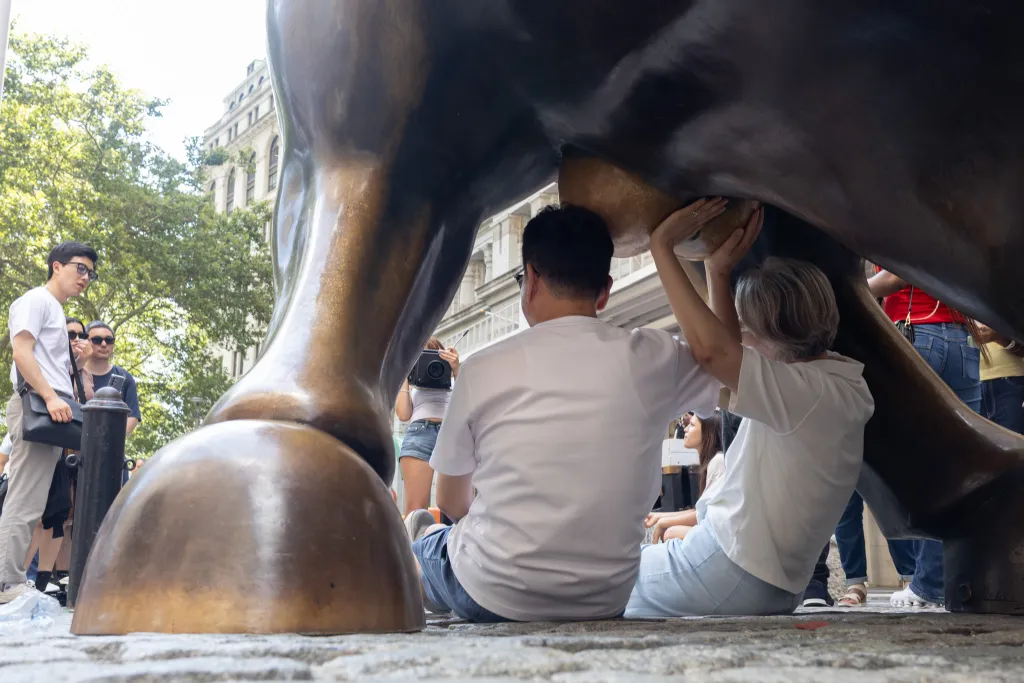
On a recent blistering day, dozens of tourists stood in line in Bowling Green, waiting to snap a photo with one of New York City’s most famous statues, “Charging Bull.”
Arthur Piccolo, the artwork’s longtime champion and steward, said he and the bull’s late creator, Arturo Di Modica, never anticipated so much hype.
“I say it’s the most popular single attraction in New York City,” Piccolo told The City Reporter in front of the statue one morning this month. “Anyone who’s ever been to New York knows about the bull, and [even] many who haven’t been.”
Yet no one seems able to say who currently owns the 7,100-lb. creation, a symbol to many of unbridled capitalism.
Di Modica reportedly put the statue up for sale in 2004 and eventually sold it to investor Joe Lewis on the condition it not be moved, according to the artist’s obituary in the New York Times, multiple media accounts over the years and the nonprofit Downtown Alliance, which manages the Lower Manhattan Business Improvement District. A 2004 Wall Street Journal article reported the artist demanded any new owner must donate the bull to the city; two years later, the then-head of city parks told the outlet that officials had suggested Di Modica donate it to the city. No subsequent ownership changes were publicly disclosed, and Di Modica died in 2021. No will for him is on file in Manhattan Surrogate Court, clerks there said this week.
Lewis, a billionaire British national, pleaded guilty in 2024 to federal insider-trading charges prosecutors later said involved him giving his personal pilot inside information to trade stocks. President Donald Trump last year pardoned Lewis, then 88.
Jessi Blakley, a spokesperson for Lewis’ investment firm Tavistock Group, told The City Reporter in an email that the Lewis family owns the original cast and rights to reproduce the bull but does not own or manage the Bowling Green statue. In response to multiple follow-ups, Blakley wrote: “The family does not own that bull.”

A spokesperson for the city Parks Department said it also doesn’t own the bull and is not responsible for its upkeep. The agency said it did have a small grant from 1999 to 2004 to perform maintenance on the artwork.
Di Modica copyrighted the work in 1998, according to U.S. Copyright Office records. He sued publisher Random House in 2009 for a book cover depicting the statue, court documents show, and in 2017 criticized the city for allowing another statue, “Fearless Girl,” to be placed in front of the bull, which he claimed altered its meaning.
Lawyer Steven Hyman, who helped represent Di Modica that year, said he believed the sculptor retained the copyright during the “Fearless Girl” dispute and had an informal agreement with the city about it remaining at Bowling Green.
Westchester County-based attorney Gaetano G. D’Antona, who represented Di Modica’s estate in settling debts after the artist’s death, said he did not know who now owns the bull.
A Hard-Charging History

The bull’s rear end and nose have grown shiny from travelers’ constant touch over the last nearly four decades. The statue has survived multiple graffiti incidents and a metal-banjo-wielding attacker since Piccolo, who heads a community group called the Bowling Green Association, said he helped convince then-Mayor Ed Koch to let the bull settle at the north end of the park.
When Di Modica was still alive, according to Piccolo, the artist paid to have one of the horns repaired after the 2019 banjo attack. Both Piccolo and the Downtown Alliance said they’ve ponied up to clean unwanted paint off the bull, but each noted they don’t have a legal obligation to care for the artwork. Di Modica’s estate did not respond to requests for comment.

Piccolo said in an interview the bull is largely self-reliant and doesn’t need much maintenance.
“It’ll be nice to have it polished occasionally, but it truthfully is not necessary,” he added. “The bronze changes color a little bit, but I’m happy with the situation the way it is right now.”
Di Modica began working on the statue after the 1987 stock market crash, spending more than $300,000 to create something he said celebrated the “strength and determination” of Americans, his New York Times obituary said. He placed the completed piece outside the New York Stock Exchange, without a permit, just before Christmas 1989.

Piccolo was commuting to his job when he first saw the bronze behemoth, he recalled.
“There was media. There were people surrounding it. It was just unbelievable. As a matter of fact, when I first saw the bull, it looked even larger than it looks for me now,” he said.
Stock Exchange officials quickly paid to have the bull removed, and it ended up in Queens, the Wall Street Journal reported at the time. Piccolo said he thought it was the end of the story, until he saw the New York Post’s front page the following day and tracked down the artist through the phone book.

Piccolo said he went to Di Modica’s studio on Crosby Street in Lower Manhattan and persuaded the sculptor to visit Bowling Green, which Piccolo saw as “dead space” in a power center. He said he wanted Di Modica to see his artwork’s potential new home, and Di Modica loved the idea.
Piccolo called then-Parks Commissioner Henry Stern, whom he said he knew through an effort to install more trees in the downtown park. Stern in turn spoke with Koch, who gave the final blessing to have the statue moved to Bowling Green, according to Piccolo.

Di Modica paid a few thousand dollars for the transfer on a flatbed truck, Piccolo said, and on Dec. 20, 1989, the bull landed at its current home.
“From that point on, people started coming in droves to the bull,” Piccolo said.
Gray Areas
Piccolo said he doesn’t have much faith in the city caring for the artwork since Bowling Green was placed on the National Register of Historic Places in 1980 and the park’s historic cast-iron fence has a yet-to-be-fixed dent. The statue currently lacks official landmark status at the local, state or federal levels, which would grant it stringent preservation protections.
In 2019, then-Mayor Bill de Blasio tried to have “Charging Bull” relocated outside the Stock Exchange, diagonal from the “Fearless Girl” statue, which had stood opposite the bull in Bowling Green from 2017 to 2018.

Piccolo said he and Di Modica vigorously opposed relocating the bull. Manhattan Community Board 1 Chair Tammy Meltzer said some local residents also opposed the move. The plan was scrapped in 2020.
Hunter College art history professor Michael Lobel said the bull is part of a long tradition of artists placing sculptures in public places, challenging traditional notions of how art derives its meaning.
“Once the work of art is put out in the world, it will take on new and unexpected meanings based on the spectator and audience,” Lobel said.

But the question of who should have responsibility for a publicly displayed sculpture once the artist dies is complicated, he said.
“My own personal view would be that for the city to care for or claim ownership of the statue creates a precedent for anyone who wants to deposit things in public space and then claim the city government has responsibility,” Lobel said. “Because it’s been there so long, it’s now in a gray area.”
Michele Bogart, an art history professor at Stony Brook University and former vice president of what’s now known as the New York City Public Design Commission, described the bull as “illegal” superficial “garden art” that should have been subject to the usual approval process for public artworks.
“There are thousands and thousands of really talented artists who would die for a chance to show their work at Bowling Green,” she said in an interview.
Welcome to New York (Tourist’s Version)
As people in line got up close to “Charging Bull” during the past few weeks, reactions to the artwork were as varied as the visitors themselves.
One Chinese tourist broke into an emotional rendition of Taylor Swift’s “Welcome to New York” when asked how she felt about the sculpture.
Belgium national Patricia Mbuyamba, 55, said she’s been to the Big Apple about a dozen times, but this was her visit to the bull. She said the city should take responsibility for the artwork.

“If you have tourists in a city, it brings money,” said Mbuyamba. “So if there’s an attraction for tourists, then I would think that the city should take care of it too.”
Several other European visitors said they waited in line to touch the bull’s testicles for financial good luck. That included Marco Lercher from Austria, who said he wanted some extra security given Europe’s troubled pension system.
“It’s like a sign for ourselves to go into the stock market when you touch the bull,” he said. “Our generation [has] to save money and invest money for ourselves because I think the states don’t have enough money in the next 50 years.”
Walder Polewacz was visiting with his family from Poland when he posed between the bull’s horns with a fake golden $100 bill. He said they planned to try their luck by buying a lotto ticket after leaving Bowling Green.

Scottish visitor Neil Fraser said he had a more nationalistic reason for checking out the statue.
“If the bull’s testicles give the Scottish football teams good luck,” he said, “I think that’s an amazing outcome.”
.entry-header {
display: none;
}
Our nonprofit newsroom relies on donations from readers to sustain our local reporting and keep it free for all New Yorkers. Donate to THE CITY today.
The post Who Owns Wall Street’s ‘Charging Bull’? Nobody Seems to Know. appeared first on The City Reporter.