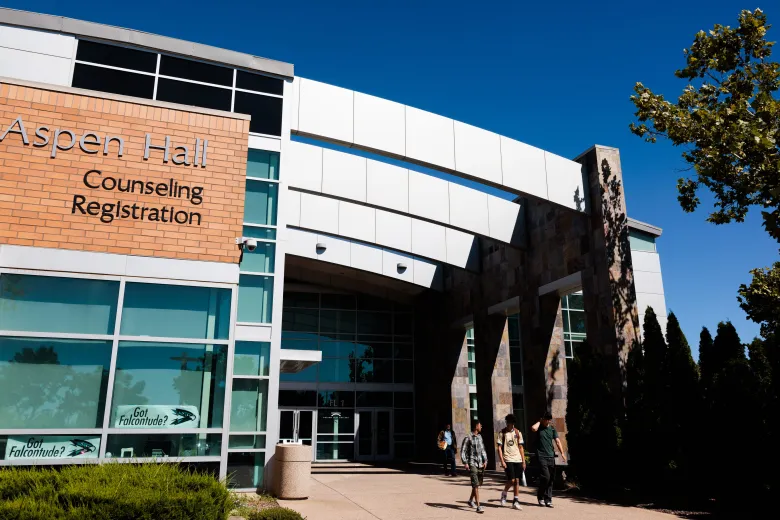

FOLSOM, Calif. — At Folsom Lake College’s main administrative building, a flyer on the wall tells undocumented students, “You can still go to college in California even with the current political climate.”
“Keep going,” it says. “You are not alone.”
Nearby is Alicia Alejo’s office at the Undocu-Falcons Center, where the student support specialist helps undocumented students access pro bono legal consults, mental health appointments, food pantries and financial aid. But during the second Trump administration’s mass deportation campaign, she said, students are keeping a low profile, sometimes opting for online-only classes and rarely getting involved with campus life — making it harder to reach them.
“I haven’t encountered a student that’s been very, you know, loud and proud,” she said. Being outspoken about their immigration status could put a target on their backs, she added.
California has become both a model and an exception nationally for the opportunities it offers undocumented students to earn a degree and enter its skilled workforce. In recent years, the state has pioneered programs that pay undocumented students to volunteer at organizations relevant to their interests, offer grants to immigrant entrepreneurs and otherwise find alternatives to federal work authorization requirements that in many states can limit people’s ability to pursue careers.
“It’s a no-brainer that this is the future workforce of this country,” said Shirley Collado, CEO of the national nonprofit College Track. “And I think California has taken the very long-term position of ‘Let’s be very invested, let’s be very thoughtful, let’s be very creative about how to best invest in every human in this state who could contribute in a valuable way.’”
Yet because of its track record in supporting undocumented students, the left-leaning state is now enmeshed in a legal battle with the Trump administration over policies that make college more accessible, with the federal government arguing that by helping undocumented students, California is discriminating against U.S. citizens. At the same time, since last summer Californians have experienced sweeping enforcement raids that have sowed fear in immigrant neighborhoods across the state.
Meanwhile, state policymakers’ innovations to support immigrant students have proven more difficult to execute than to dream up, leaving many undocumented students struggling to see the point of pursuing higher education instead of staying home to try to protect their families, in what experts warn could lead to a generational loss of talent.
Related: U.S. students face an agonizing choice: Affording college or protecting parents from deportation

California has more undocumented college students than any other state and a long history of supporting them. In 2001, it became the second U.S. state to offer most undocumented Californians the same in-state tuition as other residents, and a decade later, it was the first to provide state-based financial aid for those students, through the California Dream Act.
Since then, lawmakers have continued enacting policies to encourage college access for undocumented Californians, including by covering community college enrollment fees, opening up eligibility for student loans and requiring schools to have specialized staff who can guide undocumented scholars.
But despite those efforts, some recent signs suggest fewer undocumented students have been applying for financial aid and enrolling at four-year universities in recent years. Last academic year, there were 35,949 applications, down from nearly 50,000 just five years earlier, according to the California Student Aid Commission. And researchers found that, between 2016 and 2022, the number of low-income undocumented students enrolling at the University of California and California State University systems dropped by half.
Experts and educators attribute the declines in part to the Covid pandemic and to aggressive immigration enforcement during President Donald Trump’s first and second terms. But they also point to the fact that Deferred Action for Childhood Arrivals, the Obama-era program that deprioritized young immigrants for deportation and granted them employment authorization so they could legally work post-college, is no longer available to first-time applicants, both because it only applies to people who have resided in the U.S. since 2007 and because of Republican-led efforts to block its implementation.
At the same time, the Department of Justice has sued California and 16 other states over their tuition support for undocumented scholars, which policy experts say is making families more hesitant to have their children pursue a college degree in case tuition support disappears partway through their college careers. And even California’s laws meant to safeguard and encourage undocumented scholars — for instance, legislation passed last year that requires colleges and universities to inform students, faculty, staff and others of confirmed immigration enforcement sightings on campus — have rarely gone according to plan, as the policies lack the oversight and financial investment to be consistent and well-done on the ground.

“States have a lot to learn from California,” said Jessie Hernández-Reyes, director of policy and advocacy at the California Undocumented Higher Education Coalition. “But oftentimes, what I’m finding in this work now being in California itself is that in terms of policy implementation, we have a lot to do.”
Related: What’s happened since Texas killed in-state tuition for undocumented students
The federal government’s anti-immigrant agenda has taken a toll, separating families while depriving the U.S. of homegrown talent, educators and experts say. By one count, at least 666 children in California have been detained during Trump’s second term, and 61 percent of them have been deported — a drastic uptick in deportations of young people from 8 percent under the Biden administration.
When Christian Espinoza immigrated to California’s Inland Empire from Mexico at 9 years old, he quickly learned English and became a dedicated scholar, eventually graduating from high school among the top 10 students in his class. After studying at a community college, he transferred to his dream school, the University of California, Los Angeles, where California Dream Act grants and institutional aid helped him earn dual degrees in sociology and computer science.

At UCLA, Espinoza was surrounded by resources for undocumented students like him: scholarships for commuters, designated housing near campus and a program called the UndocuBruins Fellowship that paid scholars to do original research projects. “I felt like, I belong, because there was something for me I can tap into, something I can get paid and get money for, and someone that I can talk to about my experience,” he recalled.
After graduation, Espinoza went on to a master’s program before pursuing a Ph.D. at Claremont Graduate University researching undocumented students’ career aspirations at community colleges in Southern California.
In October 2024, he was on his way to school when he said he was stopped by immigration officers in San Bernardino and detained for a month because he lacked a legal immigration status. After his release, he caught up on his studies and applied for asylum based on being an openly gay man in Mexico, where homophobic violence has historically been common. But within a year, after Donald Trump retook the White House, he was told during immigration proceedings that he could leave the U.S. on his own or be deported.
Espinoza finished his doctorate and virtually “walked” at his graduation ceremony from his new home base in Mexico City, even as his parents, sister and extended family remained in California. Now, he is having trouble finding a job within Mexico’s radically different higher education structure, and his dreams of becoming a college dean, vice president of student affairs or director of a college affinity center are likely on hold until he can relocate elsewhere.
“I feel like my issues have always been systemic,” Espinoza said. “It’s not that I’m lazy or unmotivated or not educated. It’s a system that’s in both countries working against me, and I’m trying to figure out where I fit in.”

D.V., a DACA recipient who works for a California-based nonprofit that supports first-generation college students, said he has known undocumented scholars nationally who have been deported or who need help with requests like registering their degrees in their home countries as they prepare to leave the U.S. (He is being referred to by his initials to protect the young people he serves.) He also fields questions from students about why they should attend college at all when they can’t even get a Social Security number. And while he has talking points — a degree from a U.S. university is valid and prestigious anywhere in the world, and a college diploma may make one eligible for an employment-based visa down the line — he struggles with how to answer as he wrestles with similar insecurities about his own future.
“I love this country so much, don’t get me wrong,” he said. “And this state in particular, too, right? It’s given me so much.” At the end of the day, though, he admitted, “I also question if life is worth living here as a DACA recipient.”
Still, D.V. tries to provide options to students, including those from states with less welcoming policies. Last year, he accompanied an undocumented scholar on the long train trip from New Orleans to northern California to attend a Bay Area university that had given the teen a generous financial aid package. Without a Real ID, the student couldn’t safely fly, and his parents, also undocumented, were afraid to drive him across state lines.
It was all worth it, said D.V.: “He ended the first semester in college last fall with a 4.0.”
But at many universities and organizations, the campus resources to help these students succeed have largely gone underground, as administrators have started self-censoring to avoid funding cuts from the federal government or legal action from the Trump administration and right-wing groups.
Education professionals have noticed that scholarship providers are deleting language on their websites and in their materials explicitly saying that they accept applications from undocumented scholars. Nonprofits are doing “communications audits” — changing their mission statements, messaging and language on their websites to get rid of words like “Dreamers” that they worry are too politically charged. Recruiters for programs that help kids reach college are deleting presentation slides saying undocumented students can apply.
“When we have one-on-one conversations with different campuses and leaders, they’ll tell us, ‘We’re doing great work. We just don’t advertise it,’” said Katrina Linden, California director for Young Invincibles, an organization that amplifies young voices around affordable education and other policies. “That raises a question of, OK, how does a student actually find out about it? Is it just word of mouth?”
Experts also warn that undocumented high schoolers in California are facing pressure from their educators to opt out of financial aid applications, losing their work on the glitchy application platform, or encountering administrative delays around verifying their state residency that may eventually force them to drop out. Then, even if they reach college, they have to contend with their lack of work permits as they try to get internships and jobs.
In response to what has become a chronic problem over the decades, California universities and state lawmakers have created professional development opportunities that don’t require federal employment authorization. For instance, officials at Dream Summer, a project run by the UCLA Labor Center, say that over the last 15 years, they have provided over $6 million in fellowship awards for around a thousand undocumented students across the country to get paid over summer breaks while gaining experience at social justice organizations.
Ju Hong, director of the UCLA Labor Center’s Dream Resource Center, said he has seen a dip in interest lately that he attributes to immigrants’ fears of sharing their personal information. But he still received nearly 400 applications for just 37 spots this year. “There are some huge demands,” he said.
At the University of California, Riverside, the Butterfly Project Fellowship similarly provides scholarships to undocumented students for internships or academic research. And a state Dream Act Service Incentive Grant distributes financial awards of up to $4,500 a year for 300 or more hours of community or volunteer service.
Related: Interested in innovations in higher education? Subscribe to our free biweekly higher education newsletter.
Some advocates and lawmakers want to go a step further, proposing state legislation that would let undocumented students work at their colleges and universities, even without work permits. Champions of the bill say it could encourage more students to attend college, and to Hong, the ultimate goal — after a successful pilot within higher education — would be for undocumented professionals to eventually have access to state jobs after graduation.
“The theory is that this should apply throughout the state of California,” he said.
Until then, without a federal pathway to citizenship on the horizon for undocumented college graduates, educators in California and beyond have zeroed in on helping students build entrepreneurial skills, as even people without lawful immigration status can legally operate their own businesses in the U.S. In 2020, state lawmakers approved a grant program specifically helping immigrants and others “who face significant barriers to employment” start or maintain a business.
During a recent workday, D.V. gathered a team over Zoom to improve on a one-pager he had created outlining resources for college alumni heading into the workforce without a Social Security number or employment authorization.
“In an ideal world, my dream would be for all scholars — for undocumented scholars — to walk away from college not only with a degree, but also with a business plan, or an idea of ‘This is exactly what I’m going to do, given that I do not have a work permit,’” he said.
D.V. said he himself has started a pharmacy business in El Salvador, the nation he left at age 13, so that if he is forced to depart the U.S., he has a career as a CEO awaiting him. But he has also bought a home in California, where his wife and two U.S. citizen daughters live with him.
“These issues will not be solved after three years, when Mr. Trump is out of office, per se, right? These will be ongoing issues that we will have to see how they evolve once we have a new president,” D.V. said. “And so it’s an endless cycle.”
Contact editor Caroline Preston at 212-870-8965, via Signal at CarolineP.83 or on email at preston@hechingerreport.org.
This story about undocumented students was produced by The Hechinger Report, a nonprofit, independent news organization focused on inequality and innovation in education. Sign up for our higher education newsletter.
The post California encourages undocumented students to go to college. But some are losing hope appeared first on The Hechinger Report.
