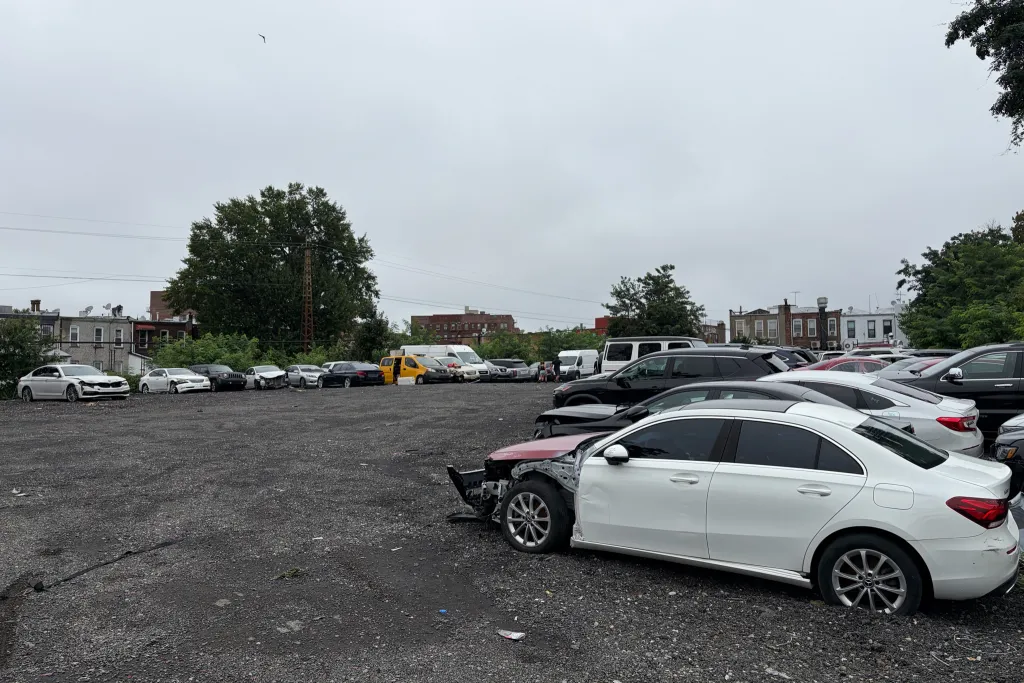
The ragged gravel parking lot in Elmhurst, Queens, looked like so many others scattered across the city — a squalid plot of open space cluttered with dozens of busted-up, broken-down cars and trucks. Some had been deposited there as part of the NYPD’s efforts to remove abandoned vehicles from city streets.
But just below the surface lay an uncomfortable truth: The owners, a limited liability corporation called 90 Queens LLC, had paved over what they knew to be a burial ground for freed African slaves dating at least to the early 1800s.
The fenced-off enclosure once served as the cemetery for the St. Mark African Methodist Episcopal Church in a Queens County haven for free Black people called Newtown. The bodies of as many as 290 formerly enslaved New Yorkers lie beneath the asphalt and impounded cars.
“These are human beings,” said Gregory Cassagnoll, who grew up in the neighborhood and is involved in a new movement to give the site proper recognition.
“It’s important because the community is being erased and that community produced prominent figures in the abolitionist movement and transatlantic history,” he said. “We would like to see a proper Elmhurst burial ground like there is one in Harlem and like there is in Downtown Manhattan.”

Cassagnoll, who’s business partners with the creators of the African Burial Ground Memorial in Lower Manhattan, says an archaeological dig at the Elmhurst site would “right this wrong.” Cassagnoll, Marc Landas, editor of the publication Scientific Inquirer, and researcher Jack Jaramill have been discussing this with Pastor Kimberly Detherage of St. Mark, which is now based in nearby Jackson Heights. (Pastor Detherage did not return The City Reporter’s calls; the church sold the original parcel nearly 100 years ago).
The group has also launched a site called “Wall of Ghosts,” which assembled biographies of Newtown’s residents as “a direct response to the physical and historical erasure of one of New York City’s most significant early free Black settlements.”
“This erasure,” the group said in a statement, “reached a tragic peak in the spring of 2026 when concrete was poured over the Elmhurst African Burial Ground by 90 Queens Inc. — a site where experts estimate the remains of up to 290 individuals lie, many of whom were enslaved people whose labor built western Queens.”
Last spring, city building inspectors declared the parking lot illegal, charging it “creates a huge hazard for the public.” Since April, 90 Queens LLC has been hit again and again with code violations, even as cars towed in a Police Department-run program to remove abandoned junkers from city streets wound up parked on top of this sacred ground.
Condo Dreams
The existence of the St. Mark cemetery has been known for decades.
The historic record indicates an African burial ground existed at the site as early as 1818, 10 years before St. Mark bought it. The church occupied it for more than a century, selling it in the 1930s and moving a mile away to Jackson Heights. The property ultimately wound up owned by a company called AMF Machine that built a factory there. In 2005, AMF decided to build an eight-story mixed-use building on part of the site, but it needed a zoning variance.
Enter New York City’s sprawling municipal government.
To obtain the variance, AMF turned to the Board of Standards and Appeals, an obscure agency that looks at whether a proposed project will fit aesthetically into a neighborhood without causing too much traffic or overburdening the existing infrastructure.
The board soon discovered the city’s Landmarks Preservation Commission had already “reviewed archaeological sensitivity models and historic maps for the site” and determined “there is a potential for the recovery of remains from a Colonial and 18th Century cemetery on the site.”
The landmarks commission recommended an archaeological study be conducted and the BSA agreed to grant the zoning waiver — as long as the owner provided the Buildings Department a letter from Landmarks laying out protocols in the event human remains were found while constructing the planned building.
The board stipulated that St. Mark AME Church had to be involved in creating those protocols. The city imposed a “restrictive declaration” on the property and AMF agreed to perform an archaeological study and adhere to the removal protocols outlined by the landmarks commission.
The Woman in the Iron Coffin
The opportunity to dig into the site’s history at that time was not to be.
In 2009, AMF Machine ditched the building project and sold the property for $5.8 million to 90 Queens LLC, which reduced the size of the project to a five-story condo that did not require a zoning variance. As a result, both the Landmarks Preservation Commission and Board of Standards and Appeals no longer had oversight over the project, and the suggestion of an archaeological documentary study disappeared.
In 2011, 90 Queens LLC began digging a foundation for the condominium, but — to absolutely no one’s surprise — a backhoe struck an object that turned out to be human remains. Amid concerns that this was a homicide victim, the city Office of the Chief Medical Examiner was summoned to the scene.
Scott Warnasch, a forensic archaeologist at the office, realized immediately this was no murder. The backhoe had shattered a 19th-century iron coffin and dragged the body out into the open. Because the coffin was airtight, the woman was so incredibly well preserved that smallpox lesions were still visible on her flesh.
Warnasch ultimately determined she was a 20-something freed Black woman who’d died of smallpox around 1850. The foundation work had also turned up other skeletal remains, confirming the presence of a larger burial ground.
This complicated the condo plan. St. Mark had earlier agreed to allow the owner to dig, but required they erect a ceremonial room honoring the burial ground in their project. The owners agreed to do this, but then stopped returning the church’s calls.
‘Pretty Ugly’
Warnasch, who acted as a liaison between the church and the Landmarks Preservation Commission, said the owners of the property were extremely resistant to complicated protocols in place to remove human remains and perform an archaeological investigation there.
“I was in some of these meetings and it got pretty ugly,” he told The City Reporter, charging that the owner “really didn’t respect this site. At some point there were dumpsters on it. Any time the developer was doing work, they were supposed to have an archaeologist on site. That didn’t happen.”
“They certainly weren’t interested in anyone crying about these bodies,” he recalled. “They just wanted the bodies out of there. They had a very callous attitude about this.”
A representative for 90 Queens LLC did not respond to calls seeking comment.
In May 2020, the company withdrew the request for a permit for the condo project. In September 2025, its new plans for the site became clear when a 311 caller notified the Buildings Department that workers were leveling the property to turn it into a parking lot.
Did the NYPD Know?
Month after month, more and more vehicles were towed onto the lot, including vehicles abandoned on the street that were targeted for removal by the NYPD’s rotation tow program.
On a visit last week, the owner of a tow truck company that regularly hauled vehicles to the lot told The City Reporter that these were vehicles “that nobody wanted.”
Last spring, City Hall learned an NYPD vendor was using the lot on top of the burial ground to store abandoned vehicles, according to a source familiar with the matter who spoke to The City Reporter on the condition of anonymity. The source noted the Buildings Department recommended strongly that the Police Department not use this lot.
A spokesperson for the NYPD, Erika Tannor, said: “The NYPD does not determine where the vehicles are taken after they’ve been towed.”
Buildings Department spokesperson Andrew Rudansky declined to comment on any communications with the NYPD, but noted that since last spring building inspectors in the agency’s padlock unit had been aggressively working to shut down the site.
Records show that between April and earlier this month, DOB hit the site three times, each time issuing violations. Inspectors found dozens of vehicles scattered about the lot, many without license plates they dubbed “dead storage.” Six-foot tall stacks of tires sat next to residential properties that surround the lot, creating a potential fire hazard. During a visit two weeks ago, inspectors declared the owners had ignored all the prior citations and the lot was still being used “illegally as a tow yard.”
As of last week, the owners had racked up more than $20,000 in fines.
Shutting Down?

Asked about the lot, Rudansky said that on Tuesday — after The City Reporter began making inquiries to city agencies about the burial ground — 90 Queens LLC had agreed to evict the operator running the lot, shut it down and remove all the vehicles and tires by Nov. 30. The City Reporter counted dozens of vehicles and multiple stacks of tires at the site Thursday.
“We will be closely monitoring the site, including the property owner’s progress in removing the vehicles,” Rudansky said, adding that the owner is still on the hook for the fines.
After Warnasch left the city chief medical examiner’s office, he participated in a documentary on the discovery of the woman in the iron coffin and is set to publish a book called “American Mummies” next spring. He said what ultimately happened at the Elmhurst site “is a shame.”
“It’s hard to say what the end result should be,” he added, “but there should be some recognition.”
Our nonprofit newsroom relies on donations from readers to sustain our local reporting and keep it free for all New Yorkers. Donate to THE CITY today.
The post They Paved a Historic Black Burial Ground. Now It’s a Lot for Abandoned Cars. appeared first on The City Reporter.