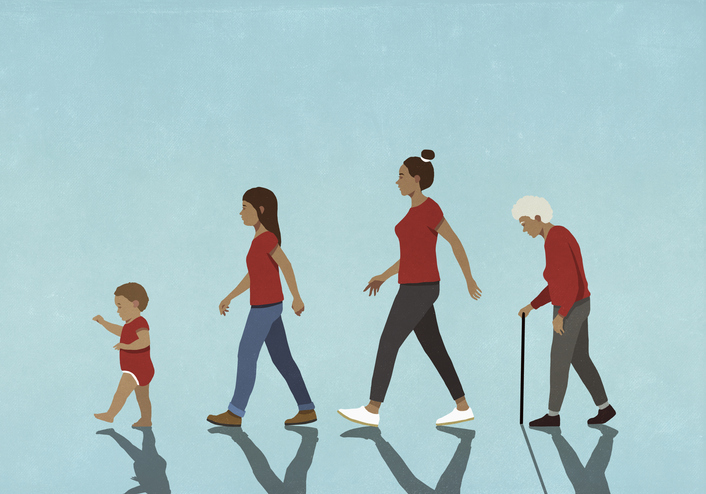
Imagine reaching age 85 with a healthy heart, normal cholesterol, excellent blood sugar, and excellent sleep, yet losing your independence because of a single hip fracture. For decades, preventive healthcare has focused on helping us live longer. The next frontier should be helping us remain mobile, independent, and strong enough to enjoy those extra years.
Every generation of healthcare has its defining category.
Forty years ago, cardiovascular health was the health “trend” to watch. Two decades ago, the tides turned toward metabolic health. Most recently, all you can hear is how you need to optimize hormones, track sleep, and maximize your longevity.
These trends are all on a similar trajectory. A condition once viewed as a narrow medical specialty became recognized as a fundamental pillar of lifelong health. New technology made measurement easier, consumers started caring more, and as healthcare economics shifted toward prevention, entire ecosystems of innovation followed.
Bone health is entering that same transformation, not because diseases like osteoporosis or osteopenia are suddenly more common, but because the conversation around it has fundamentally changed.
Bone health has been one of medicine’s largest unmet needs and opportunities for decades. In the United States alone, more than 60 million adults over age 50 either have osteoporosis or osteopenia, placing them at increased risk of fracture. Yet osteoporosis remains dramatically underdiagnosed and undertreated.
Worldwide, fragility fractures now occur at a staggering rate — approximately 37 million each year, or about one every second. Half of all women and one in four men over age 50 will experience an osteoporotic fracture during their lifetime.
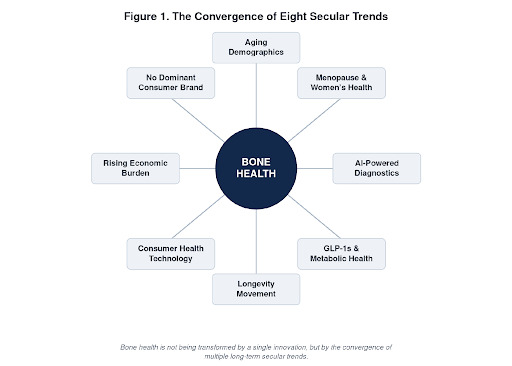
Despite this enormous burden, bone health has never become part of everyday preventive healthcare in the way cardiovascular and metabolic health have. These trends explain why that’s changing.
Bone health is the largest remaining preventive healthcare category hiding in plain sight
- Aging demographics. In 2050, the US population aged 65 and over is projected to be 83.7 million Bone density loss is a near-universal consequence of aging. This isn’t a niche patient group; it’s the fastest-growing segment of the population.
- Menopause. Estrogen plays a direct, protective role in maintaining bone density, and its decline during menopause can trigger rapid bone loss. Women can lose up to 20% of their bone density in the five to seven years following menopause. Menopause has moved from a taboo topic to a mainstream health category in recent years, and bone health is a natural, still-underserved extension of that shift.
- GLP-1s. The widespread use of GLP-1 medications for weight loss is a double-edged sword for skeletal health. Rapid weight loss is associated with loss of bone density and muscle mass. There are also clinical and research communities raising concerns that GLP-1 users could face elevated fracture risk down the line. A drug category taken by tens of millions of people is, indirectly, creating tens of millions of new candidates for bone health monitoring.
- Longevity. The longevity movement has reframed healthcare around healthspan, not just lifespan. The goal isn’t just living longer, but staying functional and independent while doing it, and a strong skeleton is essential for healthspan. A hip fracture in an older adult is one of the strongest predictors of loss of independence and mortality within the following year.
- Consumer healthcare. Wearables, direct-to-consumer testing, and at-home diagnostics have trained an entire generation to track their own health data. Bone health has largely sat outside this shift because measurement has historically required a clinical DEXA scan. As diagnostics become more accessible, bone health is positioned to join the same consumer-driven, quantified-self movement that transformed cardiovascular and metabolic health.
AI Is democratizing diagnostics
AI is expanding who gets diagnosed.
Healthcare has relied on dedicated diagnostic tests ordered after a physician suspects disease. The future looks fundamentally different. AI increasingly extracts clinically meaningful information from existing data, such as routine CT scans, chest X-rays, retinal photographs, electronic health records, wearables, and smartphones.
Healthcare has spent decades collecting enormous amounts of information. AI is finally allowing us to unlock it.
Bone health shows this clearly. Millions of CT scans happen yearly for unrelated reasons (abdominal pain, trauma, kidney stones), and they’ve always held bone density data that mostly went ignored. AI can now mine those scans for opportunistic osteoporosis screening, with dental X-rays likely next.
This is democratized diagnosis. AI will do the same for fracture-risk prediction, treatment selection, and population health management, the way data reshaped cardiovascular and diabetes care, helping clinicians know who needs intervention, which treatment fits, and how to adjust over time. Bone health ceases to be a diagnostic category and becomes a longitudinal one.
The preventive health stack is expanding — and bones are missing
Over the past decade, we’ve all embraced a new preventive health stack for the heart, brain, metabolism, sleep, and mental health. These categories have all undergone a preventive revolution. Bone has not.
Why?
- Bone health is difficult to measure
- Osteoporosis is a silent disease
- Inadequate ongoing tracking of bone density
- There are limited treatment options available
- Today, consumers are not still not largely aware of the consequences of low bone density
These barriers are now disappearing through opportunistic AI screenings, awareness of the menopause and longevity movements, and the urgency if the GLP-1-driven wave of new at-risk patients.
The future is mobility, not just osteoporosis
The future of bone health will not be defined by osteoporosis. It will be defined by mobility.
Getting there won’t take a single breakthrough. It will take three shifts happening together, each reinforcing the others, that add up to higher mobility and far fewer fractures.
- Earlier intervention. Today, bone loss is too often only caught after a fracture. Cheap DEXA scans and AI screening of routine CT and X-ray scans and risk predictors can catch low bone density years earlier, shifting care from reactive to proactive.
- Multimodal treatment. Bone health has long relied on a single prescription started late. The next generation combines exercise, nutrition, fall-risk reduction, and monitoring of factors like GLP-1 use or menopause alongside drug therapy.
- Optimizing treatment. Dosing today follows broad guidelines, not optimizing for an individual’s actual risk. Better population health and more longitudinal screening data will allow doctors to optimally sequence and adjust therapy over time, as they already do for cardiovascular disease and diabetes.
Earlier intervention catches the problem sooner and enables intervention when more effective, multimodal treatment addresses more of what actually drives fracture risk, and optimized treatment makes sure therapy keeps working over a lifetime rather than a single prescription cycle. None of these shifts depends on a single new drug or device; they depend on the data and clinical care infrastructure to make bone health as measurable and manageable as blood pressure or cholesterol already are.
Transformative healthcare categories often follow the same pattern: science advances. Technology makes diagnosis easier. Consumers become engaged and demand improved care. Prevention becomes an economic imperative. Finally, the system changes.
We believe bone health has reached that inflection point. Today, the question is no longer whether bone health will become a major category in preventive healthcare, but who will define it. Our vision is a future where fractures are rare rather than an accepted cost of aging and where millions more people stay active, mobile and strong.
That future has already begun.
Author bio:
Laura Yecies is the CEO of Osteoboost Health, Inc., the company behind the first and only FDA-cleared, non-drug wearable for low bone density. She has over 30 years of leadership experience in the technology and medical sectors. Under her leadership, the company has secured $4.7 million in NIH grants, raised $15 million in private capital, acquired and integrated the digital health platform Wellen, and generated strong sales and clinical adoption for the Osteoboost device. She also oversaw the company’s nationwide launch in May 2025, bringing proactive bone health solutions to market at scale.
Photo: Malte Mueller, Getty Images
