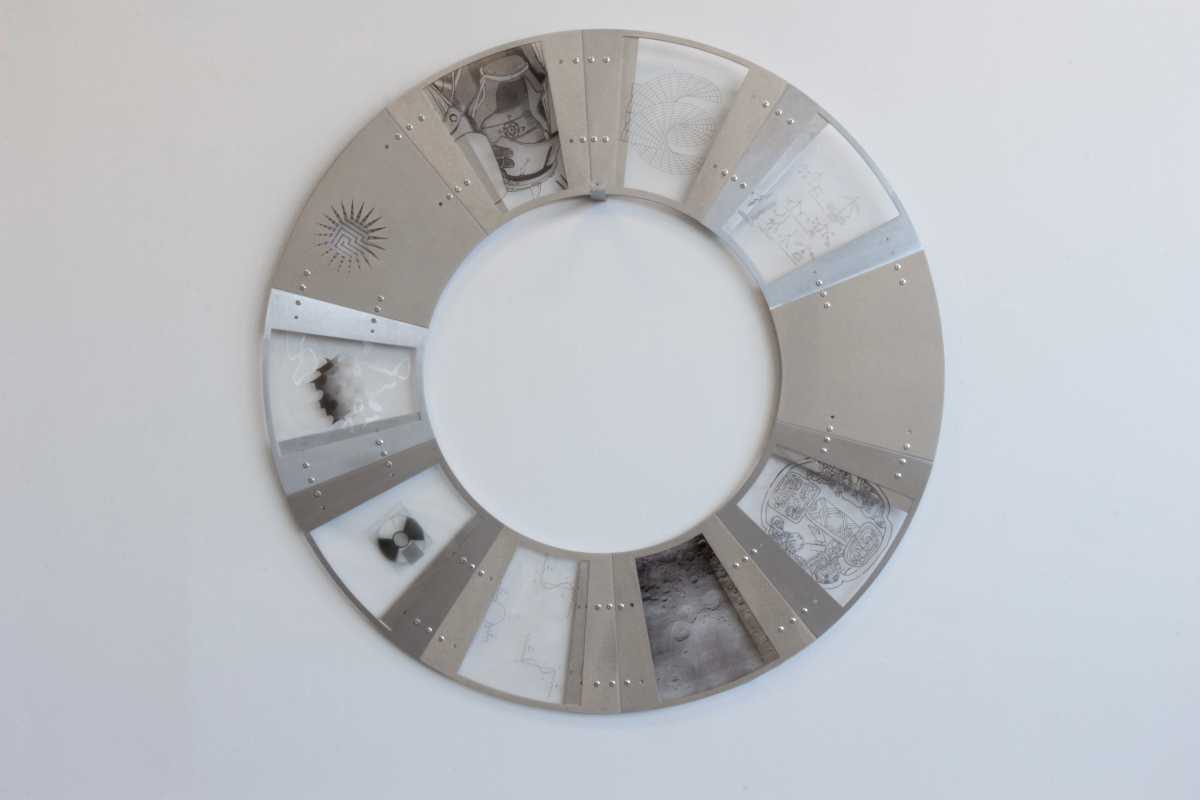
At Nunu Fine Art, The cataclysm of binary star systems asks what humanity deserves to carry into the dark—and whether memory can survive the people who made it.
Humanity has always looked to the heavens for instruction, usually after making a spectacular mess of the ground beneath its feet. Ancient Chinese astronomers organized the firmament into three enclosures and 28 lunar mansions, a celestial order of palaces, markets, and passage. The Inka, with a rather more seductive respect for absence, found llamas, serpents, and shepherds inside the dark clouds of the Milky Way instead of only among its glittering points. This weekend in SoHo, the cosmos is no longer oracle, calendar, or pretty ceiling. It is an evacuation route.
Opening Saturday, August 8, at Nunu Fine Art, The cataclysm of binary star systems is the inaugural exhibition of the New York–based 603 Arts Foundation, founded by Kate Lee and Clovis Lima Jr. Twelve artists from nine countries across Asia, Latin America, and their diasporas will participate, with four presenting work in the United States for the first time. On view through August 29, the show begins not with the polite promise of a new institution, but with the possible expiration of Earth.
The premise is gloriously catastrophic. Two stars in a binary system orbit a shared center of mass; under certain conditions, one can pull material from the other. The exhibition imagines our sun caught in that fatal intimacy until the planet becomes unlivable and its remaining inhabitants must depart. Cosmic codependency, regrettably, has no couples therapist. The astrophysics functions less as prophecy than moral ambush: stripped of home and faced with finite space, what would we consider indispensable?


Most apocalypse fantasies lavish attention on the vehicle and very little on the luggage. This one is interested in the archive. A society is not merely its monuments or official records; it is also its recipes, lullabies, jokes, languages, funeral rites, domestic gestures, forbidden books, inherited wounds, and private heresies. Technology enters, quite cleverly, as both arsonist and ark—capable of dividing, surveilling, and destroying, yet equally able to hold voices after the bodies that carried them are gone.
The exhibition’s Asian and Latin American cosmologies give that question sharper teeth. Traditional Chinese astronomy projected imperial order across the firmament, placing palaces, markets, and the emperor’s celestial realm among the constellations. Inka observers read living forms within the Milky Way’s dark spaces, treating apparent emptiness as presence. One system mapped civilization into light; the other discovered life inside shadow. Together, they ask whether humanity, given another world, would simply rebuild the old palace—or finally learn to recognize what its previous vision excluded.
The artists are not illustrations for an elegant science-fiction screenplay. Their practices complicate its seductions. Ana Won conceives artworks as temporal beings, absorbing history and material into forms that move between past, present, and speculative possibility. Leah Ying Lin brings metallic ceramics, 3D-printed metal, coding, movement, and East Asian craft into a language of future archaeology. Rithika Merchant braids comparative mythology, botanical forms, science, and imagined worlds. Keb Cerda folds gaming aesthetics and augmented reality into critiques of surveillance and media addiction, while José John Santos III allows painting, collage, assemblage, and dream logic to make ordinary reality feel rather less trustworthy.


Nunu Fine Art is an unusually apt host. Founded in Taipei by Nunu Hung and expanded to New York in 2023, the gallery’s Mandarin name plays upon the technological idea of a router: a device that gathers and transmits information. A space conceived as a relay for artistic thought will now hold an exhibition about sending the human record beyond the limits of its first home.
Perhaps the most consequential element is 603 Arts Foundation’s commitment not only to exhibition, but also to acquisition and preservation. Visibility is glamorous; custody changes history. A temporary wall offers applause, while a permanent collection determines what will be studied, insured, loaned, inherited, and eventually mistaken for the inevitable canon. Institutions have often welcomed underrepresented artists into short-term programming while leaving their holdings impeccably undisturbed. The foundation’s emphasis on building a collection suggests an understanding that cultural memory is not secured by warm language alone. Ultimately, someone must decide the work is worth keeping.
That decision sits at the show’s core. The imagined calamity may occur among stars, yet its anxiety is painfully terrestrial: migration, ecological ruin, technological appetite, political fracture, and the human talent for carrying obsolete hierarchies into supposedly new worlds. Starting over sounds romantic until one realizes who usually writes the passenger list.


The cataclysm of binary star systems offers, at least in principle, a more generous departure. Its archive is plural before it becomes interstellar; its tomorrow begins with creators whose cultures have long understood that maps, myths, and memories can survive radical displacement without remaining unchanged.
The final question is not whether another planet can hold us. It is whether, after everything we have destroyed and everything we have failed to preserve, we have become worthy of being carried there.
The exhibition opens Saturday, August 8, from 11 a.m. to 6 p.m., and remains on view through August 29 at Nunu Fine Art, 381 Broome Street in SoHo.
