Climate change often enters public conversation through maps, projections and impeccably alarming graphs. The language is technical and, at times, so abstract that the people living its consequences nearly disappear beneath the data.
Closer to the ground, however, the crisis becomes intimate. It can resemble a home health aide waiting on an overheated subway platform, a street vendor working through another punishing afternoon or a mother quietly wondering whether the air inside her apartment is safe for her child. Such moments may appear ordinary, yet they reveal precisely where environmental policy becomes human reality.
Mother Nature has long been imagined as the benevolent mother of us all: fertile, nurturing and somehow capable of repairing every injury inflicted upon her. The metaphor feels comforting until one notices the expectation beneath it. Women and the natural world have both been asked to give without limit, endure without complaint and restore what others have depleted. Even the mother of us all, it seems, is expected to perform miracles without sufficient protection.
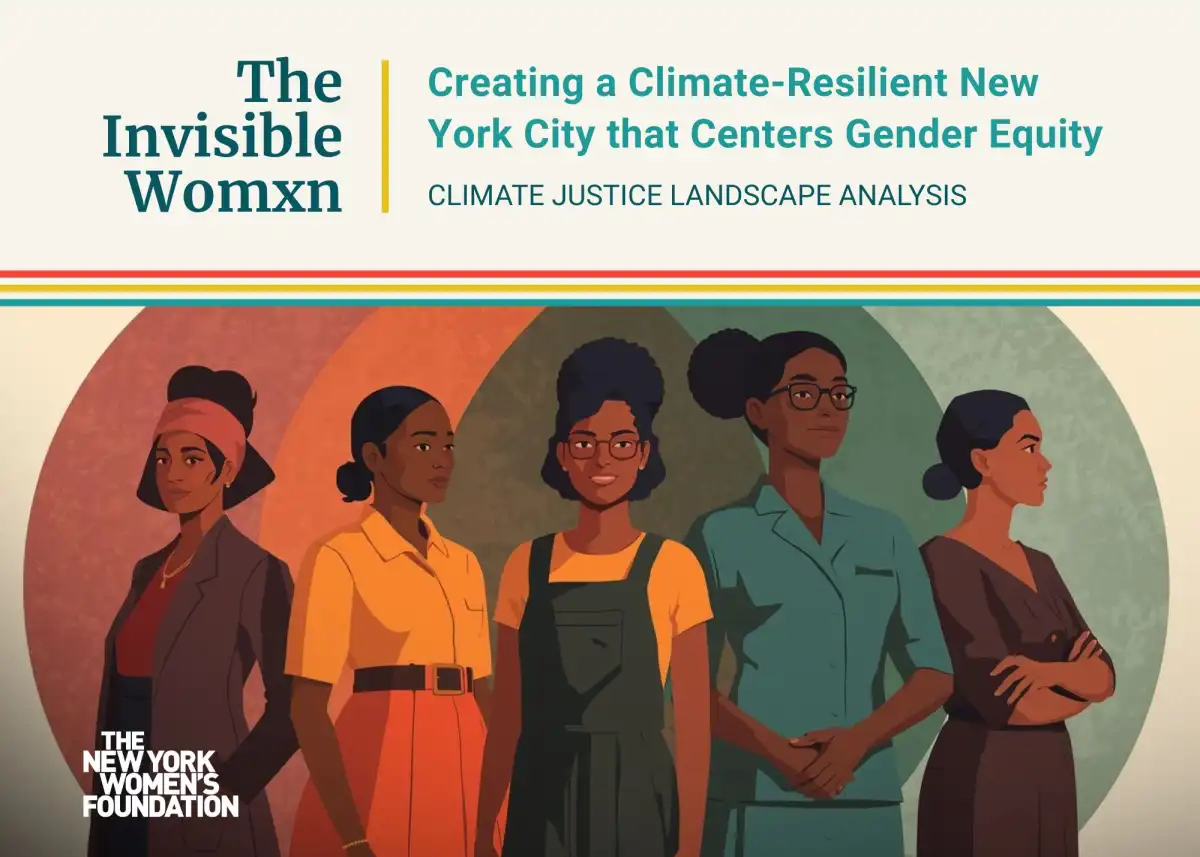
The New York Women’s Foundation brings these intertwined realities into focus with The Invisible Womxn: Creating a Climate-Resilient New York City that Centers Gender Equity. Commissioned in 2025 and written by urban sociologist Tiasia Obrien-Shah, the report examines how environmental instability disproportionately affects women and gender-expansive people of color across New York City.
Its title is appropriately unsettling. Invisibility, after all, is rarely accidental. More often, it is produced through systems that determine whose labor is documented, whose hardship becomes statistically legible and whose knowledge is considered authoritative enough to shape what happens next.
Drawing upon field visits, focus groups and interviews, Obrien-Shah reveals how climate-vulnerable workers remain absent from many of the datasets directing policy and investment. From a distance, such omissions may appear bureaucratic. Their consequences, however, are deeply material. Data influences where funding travels, which neighborhoods receive protection and whose suffering enters the official record.
A city cannot credibly call itself resilient while treating the people sustaining its communities as statistical residue.
“You cannot solve compounding harm with single issue policy,” Obrien-Shah said. “You need spatial intelligence. You need to understand place, people, and community at a local level.”
Her argument cuts through a distinctly modern delusion: the belief that expertise exists only within institutions removed from the conditions being studied. Lived experience is too often dismissed as anecdotal, while abstraction receives the glamour of authority. Knowledge does not become less rigorous simply because it was acquired while surviving the problem.
At a moment when evidence is flattened into opinion and complexity treated as an inconvenience, The Invisible Womxn restores intellectual seriousness to the climate conversation. Environmental justice requires historical memory, geographic precision and an understanding of how race, labor, housing, health and gender converge within the same life.
To mark the report’s release, The New York Women’s Foundation convened Obrien-Shah, Allyson Martinez of Brooklyn Level Up and Elizabeth Yeampierre of UPROSE and the Climate Justice Alliance for a panel moderated by Cecilia Cortes Vila.
The conversation reinforced one of the study’s most consequential conclusions: those most affected by environmental disruption must help design the response. Organizations in Environmental Justice neighborhoods are already gathering local intelligence, building support networks and developing practical strategies with a fluency that larger systems frequently lack.
Camille A. Emeagwali, senior vice president of programs and strategic learning, connected environmental vulnerability directly to economic justice. Pollution, rising temperatures and resource depletion shape wages, housing security, healthcare costs and safety at work. These are not distant ecological concerns. They enter homes, bodies, budgets and daily decisions.
That connection matters within a culture inclined to divide human crises into tidy categories. A woman does not experience extreme heat separately from unstable employment, inadequate healthcare or failing infrastructure. Harm accumulates, travels across boundaries and compounds itself. Public policy, quite sensibly, must learn to do the same.
Since 1987, The New York Women’s Foundation has awarded more than $141 million to over 500 organizations, investing in community-rooted strategies rather than imposing solutions from a comfortable distance. The approach recognizes that those holding families and neighborhoods together often possess the clearest understanding of where systems are failing—and what meaningful repair might require.
The Invisible Womxn is therefore more than a landscape analysis of New York City’s climate justice ecosystem. It is an indictment of selective vision and, perhaps more usefully, a blueprint for seeing properly.
Mother Nature may be the mother of us all, though neither she nor the communities living closest to environmental harm were meant to absorb every wound in silence.
NYWF.ORG to learn more.