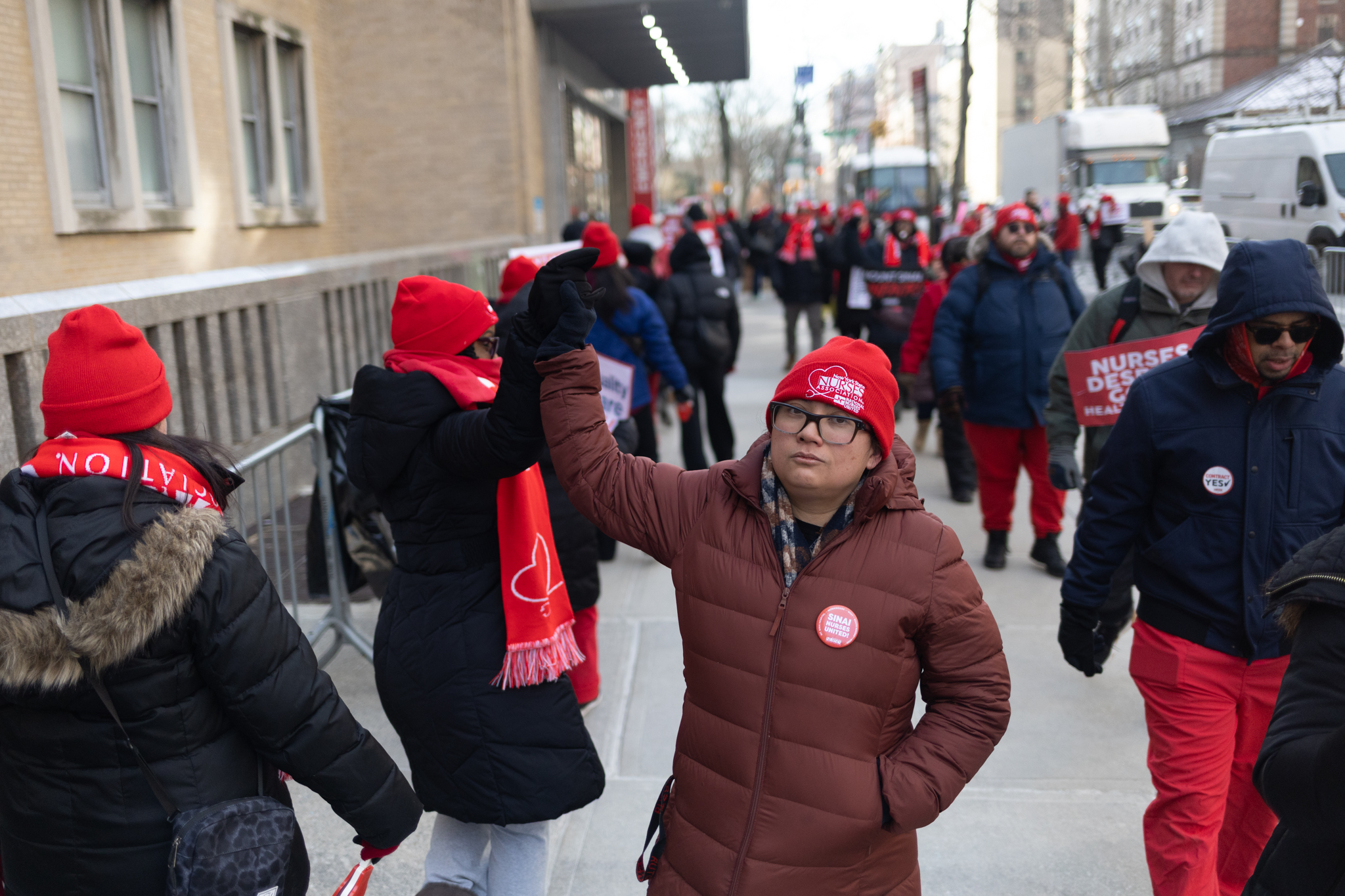
This week, after more than 10 days on the picket line, nurse Zara Roy took to the internet for help, setting up a GoFundMe while she looks for a temporary job.
While her husband, also a nurse, continues to work, they can’t pay the bills solely on his income, she said. “I’m just trying to be strong, to hold on for my family, because financially it really is a struggle.”
The mom of two from Westwood, New Jersey, has a child with disabilities, and she firmly supports the union’s demand that nurses’ health benefits remain intact. “One thing I will never, ever do,” she said, “is cross the picket line.”
Roy, a recovery room nurse at Mount Sinai Morningside, is among the 15,000 striking nurses who missed their first paychecks this week, the second full week of the strike that is the largest of its kind in New York City history. The New York State Nurses Association members have also been without health insurance coverage since walking off the job on Jan. 12.
Cash-strapped nurses are pulling their children out of day care, creating GoFundMe’s, and scouring job sites for per-diem hospital shifts and Facebook groups for nanny and home nurse gigs. Others are applying for unemployment and signing up for COBRA.
Beginning this week, the striking nurses are eligible to apply for unemployment benefits under an expansion of coverage for striking workers signed into law by Gov. Kathy Hochul last year. Though not all will apply, if even a fraction of the nurses are found eligible to receive the maximum $869 weekly benefit, the strike will cost taxpayers millions of dollars a week. Though nurses can begin applying this week, they will become eligible for benefits on Jan. 26.
Marjorie Abreu, a NICU nurse at NewYork-Presbyterian Morgan Stanley Children’s Hospital, pulled her son from day care out of fear he’d get sick and she wouldn’t be able to afford his care. The 32-year-old is also in the process of filing for unemployment.
“I’ve been working since I was 16,” she said. “I have my master’s degree, my bachelor’s. I never thought I would be in this position, unemployed and uninsured.”
NYSNA’s strike fund, which provides varying levels of financial support on an as-needed basis, has received more than 300 donations from doctors, union members, elected officials and even some celebrities since the strike began, according to a union source.
Nurses who spoke with THE CITY said they were grateful for the strike fund and unemployment benefits, but said that without their income, they are unable to pay bills or provide out-of-pocket health coverage for their families.
“It’s disgusting that [the hospitals] would put us out in the cold like this. We want to be inside taking care of our patients,” said Roy.
‘Solidarity is important to me’
Bargaining at the three striking hospital systems — Montefiore, Mount Sinai and NewYork-Presbyterian — resumed on Thursday after negotiations broke down again over the long weekend. Nurses have been picketing in freezing temperatures, and the forecast calls for a major storm on Sunday dumping more than 6 inches of snow over the five boroughs.
In the meantime, striking nurses face some tough choices. One Mount Sinai Hospital nurse practitioner, who asked to remain anonymous, was quoted nearly $4,000 a month to enroll her family in COBRA. She and her husband decided they would go without health care and enrolled only their daughter, at a cost of more than $1,000 per month.
The struggles of nurses on the picket line to make ends meet underscore some of the same issues that brought them to strike in the first place. Among their major demands is that their employers agree to keep their health coverage intact, as some hospital systems have tried to scale back or cease their contributions to the union’s health fund.
Nurses who spoke with THE CITY all agreed that missing a paycheck hurts, but going without health coverage for themselves and their dependents is even more distressing. Still, they’re maintaining their resolve.
“Solidarity is important to me, and I identify very strongly as a union nurse,” said the Mount Sinai Hospital nurse practitioner. “It’s not a good situation but this is, I think, bigger than not having income for a couple of weeks.”
Abreu, the NICU nurse, agreed, noting the union’s demands for higher nurse-to-patient ratios. “We’ve had such high acuity for a long time, and we want more for our patients,” she said.
At the picket line, nurses are maintaining a cheery disposition. Roy, the Mount Sinai Morningside nurse, on Wednesday joined her colleagues and gave passers-by high-fives.
Even amid the tumult, nurses have been buoyed by support from elected officials, including Mayor Zohran Mamdani and leaders of other unions.
The city’s worker and consumer protection commissioner, Sam Levine, joined striking nurses at the Mount Sinai Hospital picket line on Madison Avenue on Thursday and expressed his support for three labor and delivery nurses who the union says were unlawfully fired on the eve of the strike.
On Monday, the union representing medical residents and interns will join NYSNA members on the picket line if there is no deal by then, in an unusual move the Committee of Interns and Residents – SEIU described as “historic.”
Though only off-duty doctors will participate in the so-called “picket parties,” CIR-SEIU said the decision reflects the urgency of the nurses’ demands for better nurse and patient safety.
“We’re standing with NYSNA because these folks are New York’s nurses, they matter, and our city’s health depends on them having what they need,” Dr. Miledys Guzman, a Montefiore physician and CIR-SEIU member, said in a statement.
Related