The Campus begins with a deliciously subversive premise: place contemporary art inside a building once designed to teach obedience, and the architecture begins, almost inevitably, to revolt.
Set inside the former Ockawamick School in Claverack, NY, about 119 miles north of New York in Columbia County, The Campus is the brainchild of six New York-based galleries: Bortolami, James Cohan, kaufmann repetto, Anton Kern, Andrew Kreps, and kurimanzutto. They saw, in a 78,000-square-foot schoolhouse from 1951, not vacancy, but a vessel for another cultural order. The result is a collaborative art society built inside the bones of formation itself.
Without question, summer has ripped New York open: Knicks glory, World Cup heat, Pride, and civic nerve. A trip north proves, perhaps rather beautifully, that this energy does not vanish with the skyline. It changes density. It enters green landscape, old walls, and institutional quiet, becoming more cerebral, atmospheric, and available to the senses.
The former schoolhouse jolts through recognition, not sentiment. One enters and the body remembers the old contract: discipline, compliance, correction. The corridors do not need nostalgic staging. Their authority is already embedded in the air. After all, school is where many of us first learned to be measured, praised, misunderstood, and made legible.
Placed inside that architecture, contemporary art becomes a gorgeous refusal. It misbehaves in rooms built for control. The old school asked children to absorb the world as given. The art now asks adults to question who gave it shape.
With that said, the 2026 exhibition works not merely because of its scale, but because the site alters the encounter. The program, expanded through dialogue with UK galleries including Pippy Houldsworth Gallery and Modern Art, allows each room to operate less as display than argument.
Even with beloved Keith Haring subway drawings nearby, I found myself most gripped by three artists working through the figure: Qualeasha Wood, Tschabalala Self, and Matthew Monahan.
Wood, represented in London by Pippy Houldsworth Gallery, struck first as blue digital allure, then as something far more unstable. A blonde Black femme figure in an American flag bikini appears through Photo Booth language, interface bars, “Cancel,” and “Shut Down.” The image flirts with beach culture, patriotism, webcam intimacy, and cyber-kitsch, though its woven surface refuses the screen’s speed. What online culture would devour instantly has been slowed into textile.
In many ways, Wood’s inquiry into Black femme embodiment, technology, and cultural consumption becomes physically legible. The body is posed, duplicated, interrupted, and monitored, caught between desire and command. Americana becomes costume. Visibility becomes captivity. The self becomes avatar and evidence, looped inside a virtual continuum that offers recognition while extracting the image for use.
The “Shut Down” prompt cuts with brutal elegance. It reads as an interface, a plea, a threat, and exhaustion. Wood builds that condition into the fabric until the viewer feels the drag between pleasure and annihilation, between being adored as aesthetic and punished as body. Thread, usually aligned with intimacy, becomes static, surveillance, and residue.

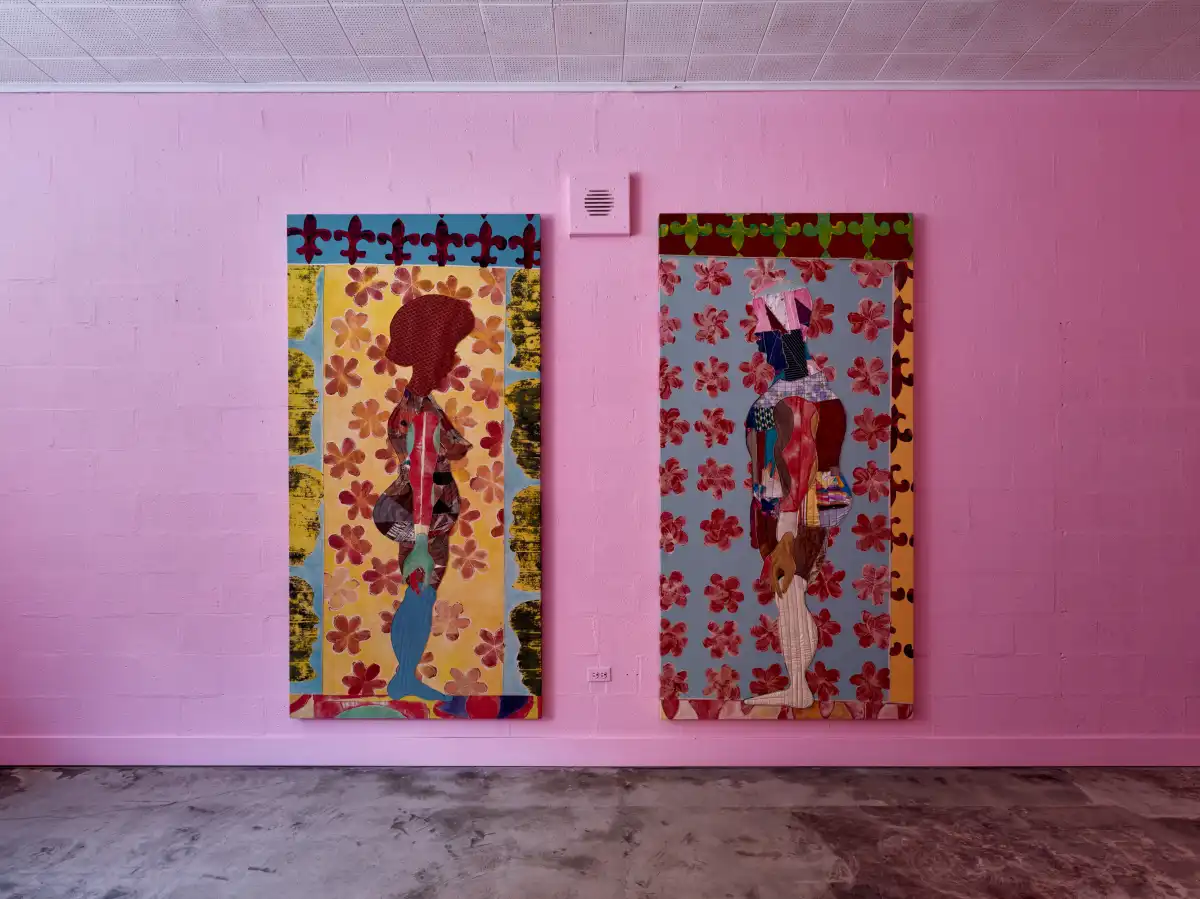
Conversely, Self’s work moves through another register. Represented in London by Pilar Corrias, Self has built a practice around sewn, printed, and painted materials that expands inquiry into selfhood and the Black body. In the work shown here, the figure appears framed, prayerful, and assembled from planes of color, fabric logic, and ornamental pressure. The saturated pink field creates an enclosure that feels devotional and theatrical, while the body turns inward, as if guarding its own interior weather.
Self’s textile and collage refuse the fantasy of a stable self. Cloth carries touch, labor, intimacy, inheritance, and social code. Pattern does not sit behind the figure; it participates in the body’s construction. The seam becomes a philosophical edge, a place where flesh, performance, and personhood are joined under pressure. Ideally, perhaps, portraiture would reveal the subject. Self suggests something sharper: identity is less essence than accumulation.
Francis Bacon becomes useful here, not as visual comparison, but as historical pressure. The Irish-born British painter, active through the violence and aftermath of the twentieth century, rejected polite abstraction for a disturbing realism that made the human figure scream, warp, and collapse inside its own psychic weather. Bacon ruminated, dissected, destroyed, then exposed. Self and Wood work through different vocabularies, certainly, yet both understand the figure as a battlefield. Bacon tore the body apart to locate the wound. Wood and Self build the surface until wound, glamour, performance, and power become inseparable.

Monahan, represented at The Campus by Anton Kern Gallery and long shown in the UK through Modern Art, shifts the conversation from body as mediated image to body as relic. His blue-gray steel head rises like a damaged monument from some archaeological future. The planes are folded, crushed, and severe, yet the face carries an almost aristocratic melancholy. Steel becomes strangely vulnerable here, bruised into consciousness.
Notably, Monahan’s broader practice challenges figuration and form, often moving between violence and delicacy, antiquity and invention, museum display and studio ruin. In this sculpture, the figure appears not as heroic permanence, but as survival under pressure. A fold becomes scar. A shadow becomes eye. A metallic plane becomes mask, armor, and wound. The work feels mythic because it refuses clean monumentality.
Together, Wood, Self, and Monahan form a fierce anatomy of contemporary personhood. Wood gives us the self trapped inside the screen. Self reveals the body as layered construction. Monahan offers the figure as remnant, scarred by history yet refusing erasure. Each artist rejects likeness as an endpoint. The human form becomes evidence of what culture has done to us, and what still resists capture.
A better world requires places like The Campus, perhaps more urgently than we admit. Not culture as accessory. Not intellect as social polish. Rather, art as disobedience, calibration, confrontation, and awakening. Art as the old lesson, finally and beautifully, interrupted.
For more information, visit thecampusupstate.com.